The warmth within: Cassini discovers heat beneath the icy surface of Saturn's moon Enceladus!

By Zee Media Bureau | Last Updated: Tuesday, March 14, 2017 - 09:44
The warmth within: Cassini discovers heat beneath the icy surface of Saturn's moon Enceladus!
Image courtesy: NASA/JPL-Caltech/Space Science Institute
New Delhi: NASA's Cassini mission is currently on its last leg and is inching toward its graceful finish in 2017. At present, the spacecraft is performing flybys of the planet Saturn, making its closest approaches to the rings.
The mission, which is about to end some time this year, has definitely been a fruitful one, owing to all the wonderfully insightful information scientists have managed to glean from it.
Every new image beamed back by Cassini carries some evolutionary secret or shows an unpredictable side of the planet or a feature that would have otherwise been impossible to find out.
Now, with another magnificent image delivered by the spacecraft, Saturn's icy moon Enceladus has been revealed to have a warmer south polar region than expected.
A new study in the journal Nature Astronomy suggests that Enceladus' ocean of liquid water might be only a couple of miles beneath this region – closer to the surface than previously thought.
The excess heat is especially pronounced over three fractures that are not unlike the "tiger stripes" – prominent, actively venting fractures that slice across the pole – except that they don't appear to be active at the moment. Seemingly dormant fractures lying above the moon's warm, underground sea point to the dynamic character of Enceladus' geology, suggesting the moon might have experienced several episodes of activity, in different places on its surface.
The finding agrees with the results of a 2016 study by a team independent of the Cassini mission that estimated the thickness of Enceladus' icy crust. The studies indicate an average depth for the ice shell of 11 to 14 miles (18 to 22 kilometers), with a thickness of less than 3 miles (5 kilometers) at the south pole, said NASA.
"Finding temperatures near these three inactive fractures that are unexpectedly higher than those outside them adds to the intrigue of Enceladus," said Cassini Project Scientist Linda Spilker at NASA's Jet Propulsion Laboratory, Pasadena, California. "What is the warm underground ocean really like and could life have evolved there? These questions remain to be answered by future missions to this ocean world," NASA reported.
First Published: Tuesday, March 14, 2017 - 09:44

Astronomers Just Found a Star Orbiting a Black Hole at 1 Percent the Speed of Light

ScienceAlert - ‎5 hours ago

Astronomers Just Found a Star Orbiting a Black Hole at 1 Percent the Speed of Light

The closest we've seen a star get to a black hole.
MIKE MCRAE
15 MAR 2017
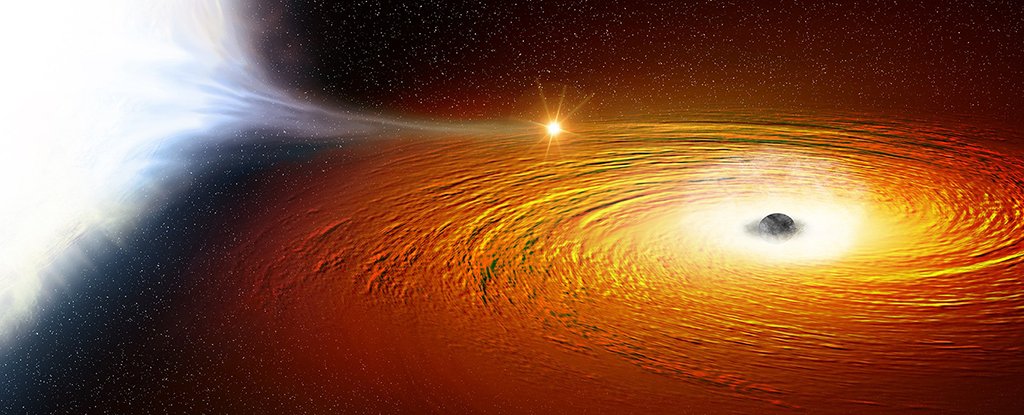
Astronomers have just spotted a star whizzing around a vast black hole at about 2.5 times the distance between Earth and the Moon, and it takes only half an hour to complete one orbit.
To put that into perspective, it takes roughly 28 days for our Moon to do a single lap around our relatively tiny planet at speeds of 3,683 kilometres (2,288 miles) per hour, meaning this star is moving at some mind-boggling, break-neck speeds.
Using data from an array of deep space telescopes, a team of astronomers have measured the X-rays pouring from a binary star system called 47 Tuc X9, which sits in a cluster of stars about 14,800 light-years away.
The pair of stars aren't new to astronomers - they were identified as a binary system way back in 1989 - but it's now finally becoming clear what's actually going on here.
"For a long time, it was thought that X9 is made up of a white dwarf pulling matter from a low mass Sun-like star," said researcher Arash Bahramian.
When a white dwarf pulls material from another star, the system is described as a cataclysmic variable star. But back in 2015, one of the objects was found to be a black hole, throwing that hypothesis into serious doubt.
Data from Chandra has confirmed large amounts of oxygen in the pair's neighbourhood, which is commonly associated with white dwarf stars. But instead of a white dwarf ripping apart another star, it now seems to be a black hole stripping the gases from a white dwarf.
White dwarfs are super dense objects that are usually the remnants of a star - think of something with the mass of our Sun but only as big as our planet - so pulling material from its surface would require some impressive gravity.
"We think the star may have been losing gas to the black hole for tens of millions of years and by now has now lost the majority of its mass," said researcher James Miller-Jones from Curtin University and the International Centre for Radio Astronomy Research.
The real exciting news, however, is regular changes in the X-rays' intensity suggest this white dwarf takes just 28 minutes to complete an orbit, making it the current champion of cataclysmic dirty dancers.
"Prior to this discovery, the closest star around any likely black hole was a system known as MAXI J1659-152, which is in an orbit with a 2.4-hour period," said Miller-Jones.
"If the likely black holes in both systems have similar masses, this would imply an orbit three times larger in physical size than the one we found in X9."
To put it in perspective, the distance between the two objects in X9 is about 1 million kilometres (about 600,000 miles), or about 2.5 times the distance from here to the Moon.
Crunching the numbers, that's a journey of roughly 6.3 million kilometres (about 4 million miles) in half an hour, giving us a speed of 12,600,000 km/hr (8,000,000 miles/hr) - about 1 percent of the speed of light.
As exciting as those figures are, the research has yet to be peer-reviewed, with the paper awaiting feedback from the physics community on the pre-publish website arXiv.org. But it's already gaining interest in the field.
"Finding these rare black holes is important, as they are not only the end points of massive stars, produced in supernova explosions, they also continue to play a role in the evolution of other stars after their deaths," Geraint Lewis from the University of Sydney told Marcus Strom at The Sydney Morning Herald.
Our two star-crossed lovers aren't fated to collapse into each other's arms any time soon, at least, with the dance looking like it will continue without the white dwarf falling into the black hole or being ripped apart.
In fact, if anything, it seems the two objects were even closer together in the past and orbiting even faster.
For the black hole to overcome the white dwarf's own intense gravity, the bodies need to be fairly close together. Over time, as material is stripped away, the now-lighter white dwarf would slip a little further back.
"Eventually so much matter may be pulled away from the white dwarf that it ends up only having the mass of a planet," said researcher Craig Heinke. "If it keeps losing mass, the white dwarf may completely evaporate."
That's good news for future scientists keen to study gravitational waves; while the current technology used by the Laser Interferometer Gravitational-Wave Observatory isn't able to spot the slow pulses emitted by X9, it's not out of the question that progress in that field will one day allow us to detect lower frequency waves.
Of course, by then we might have found a new king and queen of cataclysmic variable stars, spinning the night away at even faster speeds.
This research was published in arXiv.org.
.


PIN and passcode -imperfect science

Frightening new way thieves can steal your PIN and passcode in seconds

Komando - ‎11 hours ago‎
Criminals are always looking for new ways to rip us off. Whether it's ransomware, phishing attacks or ATM skimmers, we constantly need to be on the lookout to stay protected.
Smartphone PIN Can Be Extracted From Heat Traces Of Fingers
Scam can steal your PIN code in seconds, say scientists

How thieves can steal your PIN

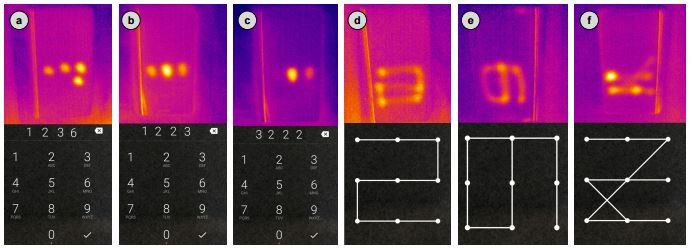
Researchers have discovered that covering your hand while typing in your PIN code isn't a secure enough procedure. That's because some high-tech thieves are using thermal cameras to steal your PIN.
How this works is, once you type in your PIN code, a thief can take a picture of the heat marks left behind on the screen with a thermal camera. They are then able to figure out the order that you typed the numbers in by the strength of the heat marks. The last number you enter will show up stronger and the first number will be lighter.
Image: Example of how criminals can steal your PIN using thermal cameras. (Source: University of Stuttgart)
This doesn't only expose the PIN code to unlock your phone either. Thieves can use this technique anywhere you type your credit or debit card PIN, such as a grocery store, gas station or ATM.
Researchers at the University of Stuttgart studied this technique of stealing PIN codes. They found that they were able to successfully decipher a users' PIN 90 percent of the time if the thermal image was captured in 15 seconds or less from the time the PIN was entered.
It's even worse for Android users. The researchers were able to figure out the correct pattern 100 percent of the time for those who use a finger-drawn pattern code. They even had more time to take the thermal image, up to 30 seconds after the pattern was drawn.
Watch the following video from a YouTuber demonstrating how simple it is for a thief to take a thermal image of a PIN.

How thieves can steal your PIN

Researchers have discovered that covering your hand while typing in your PIN code isn't a secure enough procedure. That's because some high-tech thieves are using thermal cameras to steal your PIN.
How this works is, once you type in your PIN code, a thief can take a picture of the heat marks left behind on the screen with a thermal camera. They are then able to figure out the order that you typed the numbers in by the strength of the heat marks. The last number you enter will show up stronger and the first number will be lighter.
Image: Example of how criminals can steal your PIN using thermal cameras. (Source: University of Stuttgart)
This doesn't only expose the PIN code to unlock your phone either. Thieves can use this technique anywhere you type your credit or debit card PIN, such as a grocery store, gas station or ATM.
Researchers at the University of Stuttgart studied this technique of stealing PIN codes. They found that they were able to successfully decipher a users' PIN 90 percent of the time if the thermal image was captured in 15 seconds or less from the time the PIN was entered.
It's even worse for Android users. The researchers were able to figure out the correct pattern 100 percent of the time for those who use a finger-drawn pattern code. They even had more time to take the thermal image, up to 30 seconds after the pattern was drawn.
Watch the following video from a YouTuber demonstrating how simple it is for a thief to take a thermal image of a PIN.

How to protect your PIN code

The researchers that discovered this PIN stealing possibility have a very simple solution to stop thieves from getting your code. Here are their suggestions:
  • Smartphone - Simply place your hand on the display screen after entering your PIN. This should remove all thermal traces.
  • Point-of-sale (POS) - When typing your PIN at locations such as a grocery store, gas station or ATM, place a few fingers on buttons that are not part of your code. Hold them there while you type your PIN in and leave them there for a few seconds after. This should make the digits that show up on an infrared picture useless to the scammer. They will not be able to figure out which buttons are actually part of the PIN and which were decoys.
Having a thief steal your PIN code by itself isn't a great danger to you. However, if they have installed a skimmer on a POS and get your PIN, your bank account is in serious trouble.
If it's the PIN to your phone, the thief would need to get their hands on it to cause problems. This is why you should never leave your gadget where someone can take it without your knowledge. Don't leave it on your desk at work, or anywhere for that matter, if you need to leave the room for any purpose.
Note: If you are reading this article using the Komando.com App, click here to watch the demonstration video.