Scientists pioneer novel model to turn sunlight into fuel

In a breakthrough move, British scientists have used natural sunlight to convert water into hydrogen and oxygen by mixing biological components and ...

Can sunlight be turned into fuel? Scientists introduce novel model

The team led by academics at the University of Cambridge, used semi-artificial photosynthesis to explore new ways to produce and store solar energy.

Scientists pioneer novel model to turn sunlight into fuel

Artificial photosynthesis has been around for decades but it has not yet been successfully used to create renewable energy because it relies on the use of catalysts, which are often expensive and toxic.

By: IANS | London | Published: September 4, 2018 7:06:41 pm
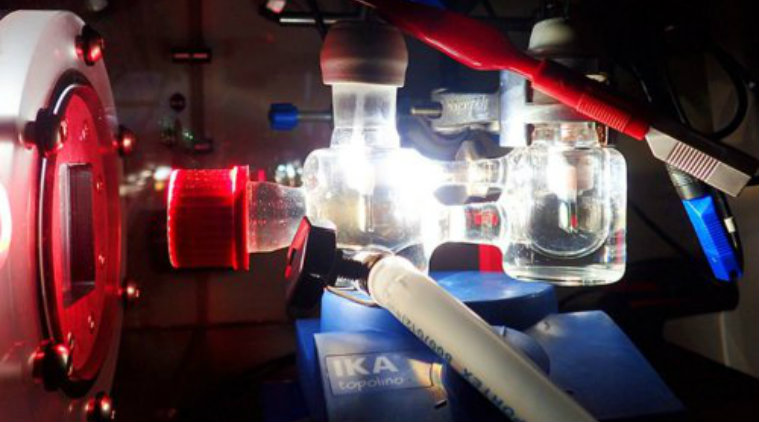
Chemistry, Hydrogen production, Chemical elements, Emerging technologies, Sustainable technologies, Oxidizing agents, Hydrogen vehicle, Oxygen, Hydrogen, Water, Water splitting, Hydrogen economy, St. John's College, man-made technologies The team not only improved on the amount of energy produced and stored, they managed to reactivate a process in the algae that has been dormant for millennia. (Image: St John’s College) In a breakthrough move, British scientists have used natural sunlight to convert water into hydrogen and oxygen by mixing biological components and man-made technologies. The team led by academics at the University of Cambridge, used semi-artificial photosynthesis to explore new ways to produce and store solar energy, a finding that could now be used to revolutionise the systems used for renewable energy production. Their method also managed to absorb more solar light than natural photosynthesis.
“Natural photosynthesis is not efficient because it has evolved merely to survive so it makes the bare minimum amount of energy needed — around 1-2 per cent of what it could potentially convert and store,” said lead author Katarzyna Soko, doctoral student at the University’s St. John’s College.
Artificial photosynthesis has been around for decades but it has not yet been successfully used to create renewable energy because it relies on the use of catalysts, which are often expensive and toxic. This means it cannot yet be used to scale up findings to an industrial level. The new model, detailed in the journal Nature Energy, is the first to successfully use hydrogenase and photosystem II to create semi-artificial photosynthesis driven purely by solar power. The team not only improved on the amount of energy produced and stored, they managed to reactivate a process in the algae that has been dormant for millennia.
Also Read: Robotic drones can herd birds away from airspaces
“Hydrogenase is an enzyme present in algae that is capable of reducing protons into hydrogen. During evolution this process has been deactivated because it wasn’t necessary for survival but we successfully managed to bypass the inactivity to achieve the reaction we wanted — splitting water into hydrogen and oxygen,” Soko explained.
Soko hopes the findings will enable new innovative model systems for solar energy conversion to be developed.
For all the latest Technology News, download Indian Express App

India's first-ever hydrogen fuel cell powered bus by Tata Motors is here ...

India's first-ever hydrogen fuel cell powered bus by Tata Motors is here ...

https://www.financialexpress.com/auto/car-news/tata...countrys-first.../1096895/
Mar 15, 2018 - A hydrogen fuel cell engine only produces water and heat as a byproduct. ... Buses thatrun on hydrogen fuel cell tech are already in use in many countries. ... Hydrogen powered Tata Starbus fuel cell bus is a zero-emission vehicle best suited for ... The company has extensively tested CNG hybrid buses.

India’s first-ever hydrogen fuel cell powered bus by Tata Motors is here! Made in India bus emits only water

Tata Motors and IndianOil Corporation will carry out testing on the new Tata Hydrogen Fuel Cell Bus for about two years before taking further decisions. A hydrogen fuel cell engine only produces water and heat as a byproduct.

By:  | Updated: March 15, 2018 1:10 PM
Tata Motors in association with Indian Oil Corporation has flagged off the trials of India's first ever Hydrogen Fuel Cell powered Bus. Indian Oil R&D is celebrating its 47th foundation day, marked by the beginning of the hydrogen fuel cell bus' testing in real world. The said project has partial financial support from Department of Science & Industrial Research, Ministry for Science & Technology and the Ministry for New and Renewable Energy. Another landmark for the hydrogen fuel cell tech is the fact that the bus was fuelled at the country's first hydrogen dispensing facility at R&D Centre of IndianOil. The two companies, Tata Motors and IndianOil will be carrying out prolonged testing of the hydrogen fuel cell bus to understand the efficiency and durability of the new and clean mobility solution in the long run in a better way.
Such projects reflect positively on the Indian government's 'Make in India' initiative with Tata Motors being on the forefront of introducing clean vehicles for mass transportation. While we've seen luxury buses from Volvo and Mercedes-Benz, Tata Motors' new buses also offer a promise for a clean environment. Buses that run on hydrogen fuel cell tech are already in use in many countries. Over 100 fuel cell buses are a part of London's transport system.
Hydrogen fuel cell technology is about three times more efficient than a traditional combustion engine. A fuel cell operates quite like a battery but without having to charge. The fuel cell generates electricity and water as long as the fuel - hydrogen and oxygen, are supplied to it.
Tata Motors first unveiled the hydrogen fuel cell bus at its Pune facility in January this year. The company launched the Starbus Electric 9m, Starbus Electric 12m and the Starbus Hybrid 12m range of buses which are designed, developed, powered by alternative fuels and made in India. Tata Starbus Fuel Cell bus produces only water and heat as a byproduct, thus, producing zero emissions.
Hydrogen powered Tata Starbus fuel cell bus is a zero-emission vehicle best suited for inter-city transportation for the masses and been developed in a partnership of ISRO (Indian Space Research Organisation).
The homegrown brand Tata Motors has a number of buses that run on alternative fuel. The company has extensively tested CNG hybrid buses. Tata also signed a contract for the largest ever single order for hybrid electric vehicle technology with the Mumbai Metropolitan Region Development Authority (MMRDA) last year.
Get live Stock Prices from BSE and NSE and latest NAV, portfolio of Mutual Funds, calculate your tax by Income Tax Calculator, know market’s Top GainersTop LosersBest Equity Funds. Like us on Facebook and follow us on Twitter.

and  steam bus 


Image result for india's steam bus


Tata Motors working on air-run cars - Livemint

Tata Motors working on air-run cars - Livemint

https://www.livemint.com › Industry › Manufacturing
Aug 29, 2012 - Tata Motors is the sole licensee of MDI's compressed air engine in India. ... to start commercial production of a car that runs on compressed air. ... Prototypes are said to have been testedby some foreign airlines for ... Once the water is split into hydrogen and oxygen, the hydrogen is used to power fuel cells.

Compressed air car - Wikipedia

https://en.wikipedia.org/wiki/Compressed_air_car
A compressed air car is a compressed air vehicle that uses a motor powered by compressed air ... 6.1 MDI; 6.2 Tata Motors; 6.3 Engineair; 6.4 Peugeot/Citroën; 6.5 APUQ .... (At 10g of water per m3 air -typical value in the summer- you have to take out ... A 2005 study demonstrated that cars running on lithium-ion batteries ..Image result for ha ha
.Image result for compressed balloon air toy car

Image result for compressed balloon air toy car

Image result for compressed air toy car