Astronomers Were Skeptical About Dark Matter — Until Vera Rubin Came Along


Pocket worthyStories to fuel your mind

Astronomers Were Skeptical About Dark Matter — Until Vera Rubin Came Along

She built a bulletproof case for exploring the concept. Vera Rubin didn’t “discover” dark matter, but she put it on the map.

Vox

Read when you’ve got time to spare.

a smiling woman wearing a colorful necklace

Photo by Linda Davidson/The Washington Post via Getty Images

Vera Rubin didn’t “discover” dark matter, but she put it on the map.

Dark matter is a wild concept. It’s the idea that some mind-boggling percentage of all the matter in the universe may be invisible, and wholly unlike the matter that makes up Earth. Rubin is celebrated because she forced much of the astronomy community to take it seriously.

That reckoning moment came in 1985, when she stood in front of the International Astronomical Union and walked the audience through some of the data she had collected.

Her data showed that stars at the edges of multiple galaxies were moving in ways that didn’t make sense, according to the rules of physics. One possible explanation for this strange phenomenon, Rubin suggested, was the existence of a mysterious “dark matter” at the edges of the galaxy. In the decades since that talk, research into dark matter has exploded, revolutionizing astronomy.

In Bright Galaxies, Dark Matter, and Beyond, a 2021 biography of Rubin, science journalist Ashley Yeager explains how Rubin, who died in 2016, grew from a young researcher whose bold ideas were initially ignored into the kind of scientist who could change an entire field. In 2020, we interviewed Yeager for an episode of the Unexplainable podcast about dark matter. A transcript of our conversation, lightly edited for length and clarity, follows.


Noam Hassenfeld

When did Vera Rubin first get interested in astronomy? What’s her origin story?

Ashley Yeager

About the age of 11 is when she started to look at the stars. Vera and her sister, Ruth, shared a bedroom in their Washington, DC, townhouse. And Ruth remembers Vera constantly crawling over her at night to be able to open the windows and look out at the night sky and start to track the stars. So clearly, Vera was captivated by the night sky. And that stuck with her.

She then went to Vassar, where she studied astronomy. [While at Vassar, she met a mathematician named Robert Rubin.] They ended up getting married. And that drove one of the biggest decisions in Vera’s life, because she wanted to go to graduate school for astronomy.

She’d gotten into Harvard, but Robert Rubin was at Cornell. He was well into his graduate studies. They had to make a choice, and Vera said, “Let’s stay together. I’ll come to Cornell with you and I’ll do my master’s in astronomy while you finish your PhD in physics.”

Noam Hassenfeld

Isn’t that kind of a wild choice? To choose Cornell based on a husband?

Ashley Yeager

It’s the late 1940s. And Vera, in some ways, was very traditional, even though she was nontraditional in other ways. She felt that she was expected to get married by the end of her four years at Vassar. That was still something that was societally kind of expected.

And I actually think it set her up to be more successful than maybe she would have been, had she gone to Harvard or Princeton or somewhere else, just because of the exposure that she got. There was intellectual freedom she had at Cornell, to be able to probe into different questions in astronomy that she probably would have been pushed away from, had she been in a more structured graduate program.

Noam Hassenfeld

So she’s at Cornell. She’s probing into questions. She’s got a lot of intellectual freedom. What are the big questions that are occupying her mind?

Ashley Yeager

The biggest one, which becomes her master’s thesis, is really the idea of “Does the universe rotate?”

Noam Hassenfeld

Wait, does the universe rotate?

Ashley Yeager

So, probably no. This was a question posed by a very eccentric astronomer named George Gamow. Vera’s husband actually showed Vera this paper that George Gamow had written about this idea. And she thought, “Well, why would we not try to answer that question?”

Noam Hassenfeld

The kind of question that, if she were at another university, maybe she wouldn’t have had the freedom to dive into?

Ashley Yeager

I think so. I get the sense, reading through the literature and looking through the history, that she probably would have been guided to a more traditional question.

And as she started to look through the data, the numbers started to suggest that there was this odd, sideways motion that perhaps could be interpreted as a universal rotation. She presented her idea to her master’s thesis adviser, William Shaw.

He says, “Your conclusion is really good. I want to present it under my name at this upcoming astronomy conference.”

And Vera is like, “No! I might not be a member of this society yet. But you’re not presenting my data for me. I’m going to present it under my own name, come hell or high water.”

Noam Hassenfeld

So does she?

Ashley Yeager

Yes. She goes to this meeting. Apparently, the drive from New York to Pennsylvania, where the meeting was, was harrowing. It was the winter, snowy. They had a newborn in the car. Her dad was actually driving because he was the only one with a car at the time.

But she gives the presentation, and the reaction is less than great. There are some heavy critics in the room. A lot of scoffing. She does have one person, Martin Schwarzschild, who encourages her. He says, “This is really interesting. But we need more data to be able to make this conclusion.”

And that’s a criticism that really sticks with her throughout her career. Later on, she really tries to have or collect as much data as possible to support her conclusions, just because of that experience.

Noam Hassenfeld

What happens next?

Ashley Yeager

She takes a little bit of a break, because she really has this strong sense of wanting to set up a home and start a family. There’s this moment in the early 1950s, when she’s at the playground with her son. She had been reading astrophysical journals to stay connected with what was going on in astronomy.

So her son’s playing in the sandbox and she’s reading the journal, and she just breaks into tears because she misses doing research so much. She misses that curiosity of asking questions and searching for data, and really trying to figure out the answers to how the universe works.

It’s at that point that her husband says, “You need to go back to school. It’s time. We’ll figure out child care. We’ll figure out how to get dinners made. But let’s do it.”

Noam Hassenfeld

So she goes back into astronomy. And eventually she starts doing research at Kitt Peak National Observatory, right? What’s that like?

Ashley Yeager

We’re talking late 1960s. This is a 84-inch telescope, very large. Vera is at the telescope with Kent Ford, her collaborator. They’re looking at this galaxy called Andromeda, which is our nearest neighbor. They’re looking at these really young, hot stars on the edge of the galaxy, and they’re trying to get the speeds of these stars — how fast are these stars going around Andromeda?

So they’re looking at the data, and they’re going, “Oh my gosh, this is not what we expected.” The assumption was that the stars closer in would fly around the sun fast, and the stars farther out would go super slow. But these stars were moving faster than they expected.

The only way for those stars far out in the galaxy to move that fast is [that] there’s got to be something happening out there that we don’t understand.

Noam Hassenfeld

What does she think is going on?

Ashley Yeager

Well, she’s not really sure. And again, she doesn’t like to make assumptions or speak without data. So she and Kent Ford, and a couple other people, they really start to do a systematic study of galaxies.

She does 20 galaxies, and then 40, and then 60. And they all show this bizarre behavior of stars, these stars out far in the galaxy, moving way, way too fast. So at that point, you know, the astronomy community is like, “Okay, we have to deal with this.”

In 1985, Vera Rubin gives this talk at the IAU. She says, “Nature has played a trick on us. That we have been studying matter that makes up only a small fraction of the universe. The rest of the universe is stuff that we don’t understand, and we can’t see it.”

And I think because she did this in so many galaxies — we’re talking 60 galaxies — there was really no denying it. It was really her work that pushed the community over the edge, to say we have to accept the idea that dark matter exists.

Noam Hassenfeld

It sounds like if you really want to upend our entire conception of the universe, you have to come with some data.

Ashley Yeager

Yeah, absolutely. Because she held onto that criticism of her master’s and PhD work — she would just go after the data, and really make sure that the story she told from that data rang true.

One of the things that made her a remarkable scientist is her perseverance. She did face a lot of roadblocks, especially because she was a woman in science in the 1940s, 1950s, 1960s. She had to really persevere. Unfortunately, she will never get to see or know what dark matter is. But I don’t know that she had a problem with that. She would take pride in the fact that she opened a whole new realm of astronomy and physics.

She basically created more questions than answers, and I think that’s the mark of a remarkable scientist: when you open up these questions that no one ever thought of before. When you create a whole new generation of scientists who can go and answer them.

The Man Who Turned Night Into Day


FYI.

This story is over 5 years old.

The Man Who Turned Night Into Day

In the 90s, a team of Russian scientists tried to use a giant space mirror to turn night into day. For a second, they succeeded.

Employers have always aimed to maximize worker productivity. Today they might exploit the connectivity of email, smartphones, and Slack to extend the reach of the modern workday, big reasons we're working more and sleeping less. In the 1990s, though, Russian scientists tried it the other way around. They took a different, more dramatic approach to lengthening the day—they launched massive machines into orbit to reflect sunlight down onto the dark side of the Earth.


It's true: Throughout the early 90s, a team of Russian astronomers and engineers were hellbent on literally turning night into day. By shining a giant mirror onto the earth from space, they figured they could bring sunlight to the depths of night, extending the workday, cutting back on lighting costs and allowing laborers to toil longer. If this sounds a bit like the plot of a Bond film, well, it's that too.

The difference is that for a second there, the scientists, led by Vladimir Sergeevich Syromyatnikov, one of the most important astronautical engineers in history, actually pulled it off.

The Big Cheese

A bright young engineer in the USSR, Vladimir Syromyatnikov graduated from a technical university in Moscow in the 1956. At the age of 23, he earned a position in Russia's elite space and rocket design program, then called the Special Design Bureau Number 1 of Research and Development Institute Number 88 (this was Soviet Russia, recall), and later known as Energia.

Syromyatnikov went to work under Sergey Korolev, the head designer of the ballistic missile that launched Sputnik—the world's first artificial satellite—into orbit in 1957. There, he helped design the world's first manned spaceship, the Vostok, that hurtled Yuri Gagarin into orbit in 1961.

The hardworking engineer quickly rose through the ranks of the Russian space program, due largely to his brilliance with docking systems. Today, he's probably best known for inventing the mechanism that allows two spacecraft to link up. He built the Androgynous Peripheral Attach System, which allowed the American and Soyuz spacecraft to connect in 1970. His designs are still used in the shuttles that dock at the International Space Station.


"We used to call him 'big cheese,' and he liked that term," Bruce Brandt, an American engineer on the Soyuz-Apollo program, told the Washington Post. "He was always thinking. If there was a problem, he always had a sketch pad. We had our shares of failures and problems in the test [phase]… but it wouldn't be long, sometimes overnight, before there would be solutions."

His system, to date, has never failed in space a single time in over 200 docking operations.

But by the late 1980s, what Syromyatnikov really wanted to do was to design a solar sail that could harness the power of the sun to propel a spacecraft through the galaxy—one that could also, say, reflect sunlight back to Earth during the dead of night.

His statesmen, however, saw a unique way to maximize labor efficiency. Throughout the Soviet era, Russian scientists were obsessed with finding ways to increase the productivity of farmlands and workers in Russia's northern regions, where days would grow very long in the summer and extremely short in the winter. In 1988, Syromyatnikov seized on the idea of daylight extension, apparently as a pitch to get backers to support his solar sails. He retooled the focus of his design to function as a space mirror, and founded the Space Regatta Consortium.

Reasoning that it could reduce energy costs for electric lighting, the company's slogan pitched its services as 'daylight all night long.'"


After the fall of the Soviet Union, the general objective remained in Russian scientific circles, driven on, perhaps, by institutional inertia.

"The initial impetus for the project was to provide illumination for industrial and natural resource exploitation in remote geographical areas with long polar nights in Siberia and western Russia, allowing outdoor work to proceed round the clock," Jonathan Crary, a professor of art and theory at Columbia University, writes in his book about the rise of the round-the-clock labor paradigm, 24/7. "But the company subsequently expanded its plans to include the possibility of supplying nighttime lighting for entire metropolitan areas. Reasoning that it could reduce energy costs for electric lighting, the company's slogan pitched its services as 'daylight all night long.'"

"Think what it will mean for the future of mankind," Syromyadnikov would later tell the Moscow Times. "No more electricity bills, no more long, dark winters. This is a serious breakthrough for technology."

He assembled a team that would build the satellite that would come to be known as the Znamya ("Banner"). It was, essentially, a 65-foot wide space mirror.

Znamya 2

"In much the way a schoolchild playing with a hand mirror learns to reflect a spot of light from a bright window into the crannies of his room, some scientists believe they can put large, orbiting mirrors above Earth that could illuminate darkened areas below with spots of reflected sunlight that measure tens of miles across," The New York Times explained in a 1993 article on Znamya.


The satellite would be launched from Earth to the Mir space station, then from Mir into orbit. Once there, it would unfurl in eight sections, spanning 20 meters, that would deflect sunlight back to earth, illuminating a nightbound hemisphere. This would, theoretically, reduce the costs of lighting existing cities, as well as allowing longer workdays in darker regions.

The project's engineers tallied its other potential boons in a document later drafted to promote Znamya:

"-a system of artificial illumination may prove invaluable for the support of rescue operations during industrial and natural disasters
-the illumination might be helpful during law-enforcement and anti-terrorist campaigns;
-the light from space can also help during special construction projects and other industrial activities"

The plan was to first test a 65-foot mirror (Znamya 2), then a 82-foot version (Znamya 2.5), finalize the test phase with a 230-foot mirror (Znamya 3), and, eventually launch a permanent 656-foot space mirror installation that would be capable of fully turning early night in Russian cities into something close to full-blown day.

"Russians to Test Space Mirror As Giant Night Light for Earth," the aptly titled Times story announced. It continues: "If it can be done, proponents say, providing sunshine at night could save billions of dollars each year in electrical lighting costs, extend twilight hours during planting and harvesting seasons to aid farmers, allow more working hours on large construction projects and help in rescue and recovery operations after natural disasters like earthquakes and hurricanes." The only thing to be lost was some sleep.


"The scheme called for a chain of many satellites to be placed in sun-synchronized orbits at an altitude of 1700 kilometers, each one equipped with fold-out parabolic reflectors of paper-thin material," Crary writes. "Once fully extended to 200 meters in diameter, each mirror satellite would have the capacity to illuminate a ten-square-mile area on earth with a brightness nearly 100 times greater than moonlight."

Building Znamya was a slapdash affair; the collapse of the Soviet Union had left the nation's science institutions under-funded, and many engineers and technicians found themselves volunteering their time to support the cause. The satellite itself was patched together from donated equipment. The financial support that did arrive came from a patchwork consortium of remaining state-owned space companies and research groups, NPO Energia among them.

After years of development, in 1992, Syromyatnikov and his team launched the 88-pound Znamya-2 into space aboard a vessel called Progress M15, bound for the Mir space station as a secondary payload.

Listen to the Radio Motherboard episode about sleep hacking your room. The podcast is available on iTunes and on your favorite podcast app.

"This should be a marvelous technical demonstration," James E. Oberg an ex-NASA expert on Russian space programs said at the time. "It's an idea they've talked about for a long time, and now they will have a chance to see if it works."


Znamya sat idle for months. "The reflector was to have been deployed in December, but Russian space authorities delayed it," the Times reported in a follow-up story. "Plans now call for the Mir astronauts to fit the drum containing Banner into the docking port of the Progress before the unmanned supply ship leaves the station on Feb. 4 or 5. When the Progress is 500 feet from Mir, Banner is to be deployed by an electric motor that spins its drum and unfolds the eight-segment reflector disk like a Japanese fan. The mirror will orbit at an altitude of about 225 miles, and from Earth will look like a bright star."

And that bright star would shine down on Earth with the light of a full moon—or more. "The experiment will test the feasibility of illuminating points on Earth with light equivalent to that of several full moons." Think about that for a second: Several full moons. The night sky can, of course, be bright indeed, like a grey twilight, with a single full moon. Several full moons would surely kill the need for a flashlight.

As planned, on February 4, Znamya left Mir. When it found its orbit a safe distance away, the mirror successfully deployed. And, sure enough, it sent a five kilometer-wide beam of light back down to Earth. The beam swept through Europe, moving from the south of France to western Russia at a reported speed of eight kilometers per second. "Several" turned out to be an overstatement—its luminosity was equivalent to a single full moon's. Unfortunately, excessive cloud cover prevented the effect from being seen much on land; as the BBC reported, some Europeans reported noticing a flash of light as it glanced by, but that was about it.


Still, the theory had proved correct, and the design was sound. Znamya was de-orbited after a few hours and burned up in the atmosphere above Canada upon reentry.

"The reflector was a big success because it proved the concept was right," Nikolai N. Sevastyanov, a ranking project engineer on Znamya told the Times. "Now we must seek support to build one of bigger size."

Znamya 2.5

Znamya 2 earned the team accolades and enough resources to pursue another go. It also net them some glowing press attention. "Russian Space Scientists Seek Eternal Light," was the headline of a July 1998 Moscow Times story, which opened as follows: "Deep in the bowels of the Russian space industry, visionary scientists have a plan to put an end to the long dark of winter… It is all so simple. Using a chain of huge mirrors suspended above Earth and angled to catch the sun's rays, they would save billions in heating and lighting bills."

After refining the designs and widening the scope—Znamya 2.5 would be 82 feet wide, and able to control and focus its light beam—Syromyatnikov and his team were eying another launch date. A cargo run to Mir was coming up in November, and, as the Moscow Times asked, "Why not just attach a giant reflective membrane to the rocket, set it loose and then bring hours of extra daylight to Russia's northern cities?"

Anticipation was growing; the boldness of the project had made it closely watched in scientific circles, and in the science-interested worldwide. And the plans were getting bolder. Znamya 3 was already beginning construction.


"We are pioneers in the field," Vladimir Syromyadnikov, now director of the Russian Space Regatta Consortium, told the Times. "If the experiment goes according to plan, we propose to send dozens more craft into space in the future on a permanent basis."

The project was assuming a grand scale, and not to everyone's liking.

"Opposition to the project arose immediately and from many directions," according to Jonathan Crary. "Astronomers expressed dismay because of the consequences for most earth-based space observation. Scientists and environmentalists declared it would have detrimental physiological consequences for both animals and humans, in that the absence of regular alternations between night and day would disrupt various metabolic patterns, including sleep. There were also protests from cultural and humanitarian groups, who argued that the night sky is a commons to which all of humanity is entitled to have access, and that the ability to experience the darkness of night and observe observe the stars is a basic human right that no corporation can nullify."

The opposition was well known to the scientists. "Russian space officials have been receiving complaints from astronomers and environmentalists that Znamya will pollute the night sky with unwanted light," the BBC reported in 1999.

The complaints weren't really about Znamya 2.5, specifically; they were about the forthcoming set of permanent space mirrors that Syromynadnikov was aiming to build. The permanent transformation of small parts of night into day.


"If it works, they'll be able to light up five or six Russian cities," the space expert Leo Enright said.

Suddenly, lighting up entire cities—even entire regions—usually darkened by night had become a palpably valid prospect. News outlets like the BBC even published guides of where the satellite's reflection would be visible, so the lucky few in position could watch a flash of light puncture the day.

So the world was watching on February 5, 1999, when the second, larger Znamya was finally thrust out of Mir.

As it was deployed, however, one of the mirrors caught on Mir's antennae, and ripped. Mission control tried to free the snagged space mirror, but it was too late. The thrashed sequel to Znamya was reluctantly de-orbited and burned up a failure.

Syromyatnikov tried to salvage the misfire, and pressed on with plans to build Znamya 3. He is listed as the sole contact person on a website built for the project at the end of 1999, and which still persists today—with his personal email and phone number attached.

"Looking forward to the space reflector experiment a lot of people all over the world and the participants interested in technical progress and investigation of the universe for peaceful goals were greatly sorry about failure to carry out the experiment completely," he writes, noting that his team received letters of support from nations around the globe. "After completing the experiment we were requested to continue the project, not to be disappointed, not lose our hearts. The way into unexploredness is a challenge."


The man who was diligently seeking to physically extend the workday with a giant space mirror wished that he himself never had to sleep.

That challenge requires substantial funding, however. Near the end of the document is an impassioned call for investors: "Actually we are considering the possibilities to repeat the Znamya-2.5 experiment, and as well as prepare and carry out the Znamya-3 experiment with the 70-meter reflector within the framework of the scheduled experimental program," he says.

"But only enthusiasm is not enough. The funding of the Znamya-2.5 experiment was extremely tight… For lack of government finances to support scientific researches we hope to find home and foreign sponsors. This is one of the way the development process of solar sail spacecraft, space illumination system and as well as other high technologies could be speeded up." (Even here, at the end he can't help but plug the solar sails that birthed the ill-fated enterprise.)

It's impossible to say how much the Znamya actually ended up costing in total—the Times reported that the Znamya 2 likely cost $10 million for the hardware alone, discounting launch costs—but Syromyatnikov was asking for over $100 million for the larger Znamya 3. He projected that ultimately, the permanent series of daylight-regulating reflectors that the Znamya experiments were leading up to would cost over $340 million to build, launch and operate. He claimed nonetheless that the perma-Znamya would be profitable in just two to three years, due to reduced lighting costs in big cities and the disaster response services it would provide.

The investors never came. After the failure of Znamy 2.5, they lost interest in the project, Znamya 3 was aborted, and Syromyatnikov was relegated to designing space mirrors only conceptually. He was forced to give up his dream of launching solar sailing ships. The quest to turn day into night from space was over, and night had won.

Hard Day's Night

Syromyatnikov went back to work on docking systems, which he would carry out until his death in 2006.

Just before he died, in 2006, he gave an interview to IEEE Spectrum, in which he recounted working nonstop, well into his 70s, often on docking mechanisms for the Soyuz rockets.

"I start my work early in the morning, usually at 5 o'clock, sometimes 4 o'clock," he said. "It's very early to bed and very early to rise. Every morning I do my physical exercises for 20 minutes to a half hour—and I work all weekends." The man who was diligently seeking to physically extend the workday with a giant space mirror wished that he himself never had to sleep.

One of Syromyatnikov's favorite slogans is, he tells IEEE, "The best rest is to work until lunchtime. So then you feel the day was not lost—and in the hours that are left you can do different activities, less critical tasks."

We are again thinking of orbital, sun-reflecting satellites. This time, the aim is primarily to beam a huge amount of solar power down to earth. The likes of US Naval Research Lab have been studying the prospect intently, and Japan's Aerospace Agency plans on launching an orbital solar power plant within the decade. The US has one that could be ready around then, too. John Mankins, the ex-NASA brain behind the US's SPS-ALPHA, argues that a "single solar power satellite would deliver power to on the order of a third of humanity." And as Syromyatnikov and his crew proved, giant space reflectors are far from the charter of science fiction alone.

The fascinating thing, in retrospect, is that Syromyatnikov himself never seemed to stop working. He seemed to actively disparage sleeping—and the night. He was always working. Even into his 70s, he adhered to a strict work regimen, toiling on docking systems for the Soyuz rockets.

"I understand how to design," he told IEEE. "You should feel, maybe by intuition, what lies ahead in the process, what should be done, not just design alone, not just the original sketches, but the whole thing."

It may be impossible for most of us to imagine the whole vision of Znamya—a world orbited by machines that regulate daylight—but we can understand the concept. It's one that's pressing up, sometimes uncomfortably in an increasingly sleepless world.

"[T]his ultimately unworkable enterprise is one particular instance of a contemporary imaginary in which a state of permanent illumination is inseparable from the non-stop operation of global exchange and circulation," Crary writes. "In its entrepreneurial excess, the project is a hyperbolic expression of an institutional intolerance of whatever obscures or prevents an instrumentalized and unending condition of visibility."

It's a world where, like today, we sleep less, cede our days to distant technologies, with more lunae crowding our vision. Imagine instead of blinking screens on the bedside, they're moonbright satellites.

Syromyatnikov's Znamya can be read both as a pathbreaking and unduly forgotten experiment, as well as a cautionary tale of human hubris, of the perils of pushing the workday too far. We may try to use technology to bend night into day, but the laws of nature have a way of bending it back.


why not permanent space reflectors?Residents enjoy winter sun reflected from mountain


"Night" is understood as the center of the Sun being below a free horizon. Since the atmosphere refracts sunlight, the polar day is longer than the polar night, ...
People also ask
01-Jul-2015 — Located more than 200 miles north of the Arctic Circle, Tromsø, Norway, is home to extreme light variation between seasons. During the Polar ...
02-Feb-2016 — The sun never fully sets and travels horizontally across the horizon throughout the night. Europe's second largest island sees no dark from ...
03-Nov-2018 — Norway during winter can be a magical time but you have to get used to the lack of light. Polar nights in Norway occur north of the Arctic ...
Missing: european ‎| Must include: european
The times for sunrise and sunset in Sweden are significantly influenced by the high location in the northern hemisphere. Relatively high in the north, the days ...

14-Mar-2017  This is certainly the case in another Norwegian settlement: Tromso. One of the world's most northerly cities, it is some 400km north of the ...

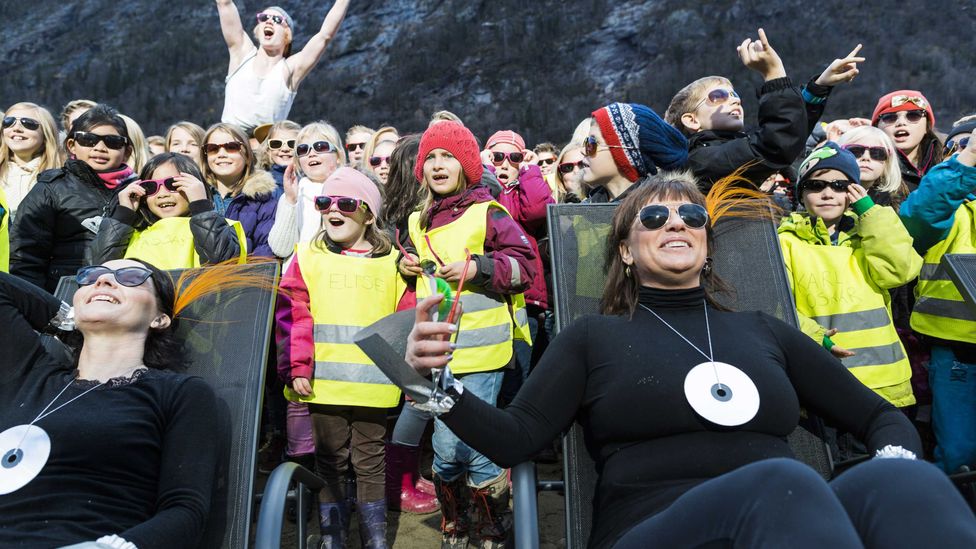
People cheer during an inauguration of the Sun mirrors (Credit: Krister Soerboe/AFP/Getty Images)

People cheer during an inauguration of the Sun mirrors (Credit: Krister Soerboe/AFP/Getty Images)

The dark town that built a giant mirror to deflect the Sun
Share on Linkedin
The mirrors are mounted in such a way that they turn to keep track of the Sun (Credit: Getty Images)

From Mosaic

A Norwegian town shrouded in shadow for half the year has found an ingenious way to get a bit of sunlight. But why go to such extreme measures? As Linda Geddes discovers, the Sun has powerful effects on our minds and bodies – and it changes us when it’s absent.

Article continues below

T

The inhabitants of Rjukan in southern Norway have a complex relationship with the Sun. “More than other places I’ve lived, they like to talk about the Sun: when it’s coming back, if it’s a long time since they’ve seen the Sun,” says artist Martin Andersen. “They’re a little obsessed with it.” Possibly, he speculates, it’s because for approximately half the year, you can see the sunlight shining high up on the north wall of the valley: “It is very close, but you can’t touch it,” he says. As autumn wears on, the light moves higher up the wall each day, like a calendar marking off the dates to the winter solstice. And then as January, February and March progress, the sunlight slowly starts to inch its way back down again.

Rjukan was built between 1905 and 1916, after an entrepreneur called Sam Eyde bought the local waterfall (known as the smoking waterfall) and constructed a hydroelectric power plant there. Factories producing artificial fertiliser followed. But the managers of these factories worried that their staff weren’t getting enough Sun – and eventually they constructed a cable car in order to give them access to it.

When Martin moved to Rjukan in August 2002, he was simply looking for a temporary place to settle with his young family that was close to his parents’ house and where he could earn some money. He was drawn to the three-dimensionality of the place: a town of 3,000, in the cleft between two towering mountains – the first seriously high ground you reach as you travel west of Oslo.

Rjukan sits at the base of a valley in in southern Norway (Credit: Olav Gjerstad/Flickr/CC BY 2.0)

Rjukan sits at the base of a valley in in southern Norway (Credit: Olav Gjerstad/Flickr/CC BY 2.0)

I felt it very physically; I didn’t want to be in the shade – Martin Andersen

But the departing Sun left Martin feeling gloomy and lethargic. It still rose and set each day, and provided some daylight – unlike in the far north of Norway, where it is dark for months at a time – but the Sun never climbed high enough for the people of Rjukan to actually see it or feel its warming rays directly on their skin.

As summer turned to autumn, Martin found himself pushing his two-year-old daughter’s buggy further and further down the valley each day, chasing the vanishing sunlight. “I felt it very physically; I didn’t want to be in the shade,” says Martin, who runs a vintage shop in Rjukan town centre. If only someone could find a way of reflecting some sunlight down into the town, he thought. Most people living at temperate latitudes will be familiar with Martin’s sense of dismay at autumn’s dwindling light. Few would have been driven to build giant mirrors above their town to fix it.

Dark place

What is it about the flat, gloomy greyness of winter that seems to penetrate our skin and dampen our spirits, at least at higher latitudes? The idea that our physical and mental health varies with the seasons and sunlight goes back a long way. The Yellow Emperor’s Classic of Medicine, a treatise on health and disease that’s estimated to have been written in around 300 BCE, describes how the seasons affect all living things. It suggests that during winter – a time of conservation and storage – one should “retire early and get up with the sunrise... Desires and mental activity should be kept quiet and subdued, as if keeping a happy secret.” And in his Treatise on Insanity, published in 1806, the French physician Philippe Pinel noted a mental deterioration in some of his psychiatric patients “when the cold weather of December and January set in”.

Why should darker months trigger this tiredness and low mood in so many people?

Today, this mild form of malaise is often called the winter blues. And for a minority of people who suffer from seasonal affective disorder (SAD), winter is quite literally depressing. First described in the 1980s, the syndrome is characterised by recurrent depressions that occur annually at the same time each year.

Even healthy people who have no seasonal problems seem to experience this low-amplitude change over the year, with worse mood and energy during autumn and winter and an improvement in spring and summer.

The light shines on the town square but not the rest of Rjukan (Credit: Getty Images)

The light shines on the town square but not the rest of Rjukan (Credit: Getty Images)

Why should darker months trigger this tiredness and low mood in so many people? There are several theories, none of them definitive, but most relate to the circadian clock. One idea is that some people’s eyes are less sensitive to light, so once light levels fall below a certain threshold, they struggle to synchronise their circadian clock with the outside world. Another is that some people produce more of a hormone called melatonin during winter than in summer.

However, the leading theory is the ‘phase-shift hypothesis’: the idea that shortened days cause the timing of our circadian rhythms to fall out of sync with the actual time of day, because of a delay in therelease of melatonin. Levels of this hormone usually rise at night in response to darkness, helping us to feel sleepy, and are suppressed by the bright light of morning. “If someone’s biological clock is running slow and that melatonin rhythm hasn’t fallen, then their clock is telling them to keep on sleeping even though their alarm may be going off and life is demanding that they wake up,” says Kelly Rohan, a professor of psychology at the University of Vermont. Precisely why this should trigger feelings of depression is still unclear. One idea is that this tiredness could then have unhealthy knock-on effects. If you’re having negative thoughts about how tired you are, this could trigger a sad mood, loss of interest in food, and other symptoms that could cascade on top of that.

However, recent insights into how birds and small mammals respond to changes in day length have prompted an alternative explanation. According to Daniel Kripke, an emeritus professor of psychiatry at the University of California, San Diego, when melatonin strikes a region of the brain called the hypothalamus, this alters the synthesis of another hormone – active thyroid hormone – that regulates all sorts of behaviours and bodily processes.

For approximately half the year, you can see the sunlight shining high up on the north wall of the valley above Rjukan (Credit: Bilfinger SE/Flickr/CC BY 2.0)

For approximately half the year, you can see the sunlight shining high up on the north wall of the valley above Rjukan (Credit: Bilfinger SE/Flickr/CC BY 2.0)

When dawn comes later in the winter, the end of melatonin secretion drifts later, says Kripke. From animal studies, it appears that high melatonin levels just after the time an animal wakes up strongly suppress the making of active thyroid hormone – and lowering thyroid levels in the brain can cause changes in mood, appetite and energy. For instance, thyroid hormone is known to influence serotonin, a neurotransmitter that regulates mood. Several studies have shown that levels of brain serotonin in humans are at their lowest in the winter and highest in the summer.

It’s possible that many of these mechanisms are at work, even if the precise relationships haven’t been fully teased apart yet. But regardless of what causes winter depression, bright light – particularly when delivered in the early morning – seems to reverse the symptoms.

Mirror, mirror

It was a bookkeeper called Oscar Kittilsen who first came up with the idea of erecting large rotatable mirrors on the northern side of the valley above Rjukan, where they would be able to “first collect the sunlight and then spread it like a headlamp beam over the town and its merry inhabitants”.

A month later, on 28 November 1913, a newspaper story described Sam Eyde pushing the same idea, although it was another hundred years before it was realised. Instead, in 1928, Norsk Hydro erected a cable car as a gift to the townspeople, so that they could get high enough to soak up some sunlight in winter. Instead of bringing the Sun to the people, the people would be brought to the sunshine.

The mirrors are mounted in such a way that they turn to keep track of the Sun (Credit: Getty Images)

The mirrors are mounted in such a way that they turn to keep track of the Sun (Credit: Getty Images)

Martin Andersen didn’t know all of this. But after receiving a small grant from the local council to develop the idea, he learned about this history and started to develop some concrete plans. These involved a heliostat: a mirror mounted in such a way that it turns to keep track of the Sun while continually reflecting its light down towards a set target – in this case, Rjukan town square.

The three mirrors stand proud upon the mountainside

The three mirrors, each measuring 17 sq m, stand proud upon the mountainside above the town. In January, the Sun is only high enough to bring light to the square for two hours per day, from midday until 2pm, but the beam produced by the mirrors is golden and welcoming. Stepping into the sunlight after hours in permanent shade, I become aware of just how much it shapes our perception of the world. Suddenly, things seem more three-dimensional; I feel transformed into one of those ‘merry inhabitants’ that Kittilsen imagined. When I leave the sunlight, Rjukan feels a flatter, greyer place.

Not everyone in Rjukan has welcomed the Sun mirrors with open arms. Many of the locals I spoke to dismissed them as a tourist gimmick – though all admitted they were good for business. On the day I visited, the town was blessed with clear blue skies and a golden shaft of light descending from the mirrors, yet few people lingered in the town square. In fact, of the people I spoke to, it was recent immigrants to Rjukan who seemed most appreciative of the mirrors.

People cheer during an inauguration of the Sun mirrors (Credit: Krister Soerboe/AFP/Getty Images)

People cheer during an inauguration of the Sun mirrors (Credit: Krister Soerboe/AFP/Getty Images)

Andersen admits to having got used to the lack of sunlight over time. “I don’t find it so bad anymore,” he says. It’s as though the people who’ve been brought up in this uniquely shady place, or who have chosen to stay, have grown immune to the normal thirst for sunlight.

This is certainly the case in another Norwegian settlement: Tromso. One of the world’s most northerly cities, it is some 400km north of the Arctic Circle. Winter in Tromso is dark – the Sun doesn’t even rise above the horizon between 21 November and 21 January. Yet strangely, despite its high latitude, studies have found no difference between rates of mental distress in winter and summer.

One suggestion is that this apparent resistance to winter depression is genetic. Iceland similarly seems to buck the trend for SAD: it has a reported prevalence of 3.8%, which is lower than that of many countries farther south. And among Canadians of Icelandic descent living in the Canadian province Manitoba, the prevalence of SAD is approximately half that of non-Icelandic Canadians living in the same place.

Some people have an apparent resistance to winter depression – why?

However, an alternative explanation for this apparent resilience in the face of darkness is culture. “To put it brutally and brief: it seems like there are two sorts of people who come up here,” says Joar Vitterso, a happiness researcher at the University of Tromso. “One group tries to get another kind of work back down south as soon as possible; the other group remains.”

Ane-Marie Hektoen grew up in Lillehammer in southern Norway, but moved to Tromso 33 years ago with her husband, who grew up in the north. “At first I found the darkness very depressing; I was unprepared for it, and after a few years I needed to get a light box in order to overcome some of the difficulties,” she says. “But over time, I have changed my attitude to the dark period. People living here see it as a cosy time. In the south the winter is something that you have to plough through, but up here people appreciate the very different kind of light you get at this time of year.”

Looking down on Rjukan, the path of the reflected sunlight (Credit: Krister Soerboe/AFP/Getty Images)

Looking down on Rjukan, the path of the reflected sunlight (Credit: Krister Soerboe/AFP/Getty Images)

Stepping into Hektoen’s house is like being transported into a fairy-tale version of winter. There are few overhead lights, and those that do exist drip with crystals, which bounce the light around. The breakfast table is set with candles, and the interior is furnished in pastel pinks, blues and white, echoing the soft colours of the snow and the winter sky outside. It is the epitome of kos or koselig – the Norwegian version of hygge, the Danish feeling of warmth and cosiness.

The period between 21 November and 21 January in Tromso is known as the polar night, or dark period, but for at least several hours a day it isn’t strictly speaking dark, but more of a soft twilight. Even when true darkness does descend, people stay active. One afternoon I hire a pair of cross-country skis and set off down one of the street-lit tracks that criss-cross the edge of the city. Despite the darkness, I encounter people taking dogs for walks on skis, a man running with a head torch, and countless children having fun on sledges. I stop at a park and marvel at a children’s playground lit up by floodlights. “Do children climb here in winter?” I ask a young woman, who is struggling to pull on a pair of ice skates. “Of course,” she answers. “It’s why we have floodlights. If we didn’t, we’d never get anything done.”

Residents gather to enjoy the light (Credit: Getty Images)

Residents gather to enjoy the light (Credit: Getty Images)

It sounds dismissively simple, but a more positive attitude really might help to ward off the winter blues

During 2014-15, a psychologist from Stanford University called Kari Leibowitz spent 10 months in Tromso trying to figure out how people cope during the cold, dark winters. Together with Vitterso, she devised a ‘winter mindset questionnaire’ to assess people’s attitudes to winter in Tromso, the Svalbard archipelago and the Oslo area. The farther north they went, the more positive people’s mindsets towards winter were, she tells me. “In the south, people didn’t like winter nearly as much. But across the board, liking winter was associated with greater life satisfaction and being willing to undertake challenges that lead to greater personal growth.”

It sounds dismissively simple, but adopting a more positive attitude really might help to ward off the winter blues. Kelly Rohan recently published a clinical trial comparing cognitive behavioural therapy (CBT) to light therapy in the treatment of SAD, and found them comparable during the first year of treatment. CBT involves learning to identify patterns and errors in one’s way of thinking and challenging them. In the case of SAD, that could be rephrasing thoughts such as ‘I hate winter’ to ‘I prefer summer to winter’, or ‘I can’t do anything in winter’ to ‘It’s harder for me to do things in winter, but if I plan and put in effort I can’.

It also involves finding activities that a person is willing to do in winter, to pull them out of hibernation mode. “I don’t argue that there isn’t a strong physiological component to seasonal depression, which is tied to the light-dark cycle,” says Rohan. “But I do argue that the person has some control over how they respond to and cope with that. You can change your thinking and behaviour to feel a bit better at this time of year.”

This is an edited version of an article first published by Wellcome on Mosaic and is republished here under a Creative Commons licence. Visit Mosaic to read the longer version, which also describes how artificial light can regulate mood.

==================================================================


why not permanent space reflectors TO LIGHT STREETS AT NIGHT?

TO LIGHT EARTH AT NIGHT ?

Space mirror "illumines" Europe by night
Down To Earth

Space mirror "illumines" Europe by night

Space mirror "illumines" Europe by night

A Russian attempt to light up the night by using sunlight reflected from a huge space-based mirror failed to come up to expectations but could some day provide an alternative to electric lighting.

Published: Thursday 15 April 1993

--WHILE it was still dark on a recent February night, a swath of light streaked across Europe for a few moments, telling the world that brightness at midnight had become a reality.

For six minutes beginning 0522 GMT (1052 AM in India) on February 4, sunlight reflected by a space-based, circular mirror sped rapidly from Lyons in France to Brest in Belarus. Made of Kevlar -- a tough material also used in making bullet-proof vests -- and thinner than a human hair, the 20-metre mirror was unfurled from an unmanned Russian supply spacecraft alongside the Mir space station.

Russian scientists had claimed the mirror would be "as bright as several full moons" and would illuminate people in the streets "like actors on the stage". But in southern France, the mirror was visible only as a bright spot and its ground illumination was much less than ordinary moonlight.

The experiment, supported by the Russian space company, Energiya, was intended to show that mirrors deployed in space could save vast amounts of electricity by providing solar light to regions where winter night can last for months. The experiment also sought to show reflected sunlight could help in rescue operations after natural disasters like earthquakes and hurricanes that disrupt local power supply.

However, the experiment seems to have upset astronomers. Peter Andrews of UK's Royal Greenwich Observatory explained that light reflected by ordinary mirrors, howsoever faint, would interfere with observations through telescopes. Paul Murdin, who heads an International Astronomical Union panel on observatory protection, said safeguards would have to be taken to protect delicate instruments if the Russians expand their space mirror project.

However, observers predict there is little likelihood of Energiya continuing with the project because it is running out of money. Viktor Blagov, director of the Russian space flight control centre at Kaliningrad, said, "We need to collect money to continue the programme."

Clearly, the Russians have miles to go before their space mirrors can turn night into day.


Russians to Test Space Mirror As Giant Night Light for Earth - The New York  Times
The New York Times
Russians to Test Space Mirror As Giant ...


Russians to Test Space Mirror As Giant Night Light for Earth

Credit...The New York Times Archives
See the article in its original context from
January 12, 1993, Section C, Page 1Buy Reprints
TimesMachine is an exclusive benefit for home delivery and digital subscribers.
About the Archive
This is a digitized version of an article from The Times’s print archive, before the start of online publication in 1996. To preserve these articles as they originally appeared, The Times does not alter, edit or update them.
Occasionally the digitization process introduces transcription errors or other problems; we are continuing to work to improve these archived versions.

RUSSIAN scientists are planning soon to unfurl a glistening sheet of plastic in space as a first step toward testing an intriguing notion about turning night into day -- or at least twilight.

Tucked aboard a Progress cargo spacecraft attached to the Mir space station is an experiment called Znamya, or Banner, that will test the idea of using a mirror in space to reflect sunlight down to Earth.

If all goes as planned, the Banner payload will be deployed next month to unfurl into a 65-foot-diameter disk of aluminum-coated plastic film. The experiment will test the feasibility of illuminating points on Earth with light equivalent to that of several full moons.

Russian engineers say it should also teach them a lot about handling thin sheets of plastic in space, a step toward developing large sails to propel ships in space using the faint force of sunlight.

"This should be a marvelous technical demonstration," said James E. Oberg of Houston, an expert on Russian space programs who wrote the book "Red Star in Orbit."

"It's an idea they've talked about for a long time, and now they will have a chance to see if it works."

The Sun is always shining somewhere on Earth, of course, if not always where people need or want it. But what if someone put a big reflector high in space to peer over the curvature of Earth, capture some of the Sun's rays and shine them down on the dark side?

In much the way a schoolchild playing with a hand mirror learns to reflect a spot of light from a bright window into the crannies of his room, some scientists believe they can put large, orbiting mirrors above Earth that could illuminate darkened areas below with spots of reflected sunlight that measure tens of miles across.

If it can be done, proponents say, providing sunshine at night could save billions of dollars each year in electrical lighting costs, extend twilight hours during planting and harvesting seasons to aid farmers, allow more working hours on large construction projects and help in rescue and recovery operations after natural disasters like earthquakes and hurricanes.

A consortium of state-owned companies and agencies in Russia, headed by the NPO Energia space company, is sponsoring the mirror-solar sail demonstration. The project is using some donated equipment, and engineers and technicians are volunteering their time. Proponents of the project hope a successful test will attract financial support from Western companies and the Russian Government.

The idea of using mirrors in space like giant spotlights was proposed in 1929 by Hermann Oberth, a German scientist and space visionary. The idea was further developed by scientists in the United States and in the former Soviet Union, where it remains particularly popular because of its potential usefulness for lighting northern Siberia and other areas near the Arctic Circle during the long polar nights.

Although both the Pentagon and the National Aeronautics and Space Administration considered solar reflectors from time to time in the last two decades, they never developed them. Ambitious Goals

But Russian theorists have eagerly proposed solar reflector systems that could constantly illuminate areas the size of several cities every night. The most ambitious proposal foresees a constellation of 100 reflectors, each 1,300 feet in diameter with a surface area of 30 acres.

Initial operational systems, using reflectors 650 feet in diameter, would have 24 to 36 mirrors in northern inclination orbits either 620 miles or 3,700 miles above Earth, proponents say. A reflector could light a spot by itself or several could be focused on the same area for continuous illumination or greater brightness, scientists say, producing the light of up to 50 full moons. These mirrors, which would pivot as they passed overhead to keep their light on the same spot, could illuminate surface areas 35 miles to 55 miles across.

While the idea of space mirrors fascinates some, others have wondered about possible environmental effects of interrupting the normal day-night cycle of animals and plants, particularly if the practice became widespread.

Even extended daylight would affect the development and behavior of flora and fauna, and might influence local weather. After Soviet scientists first proposed launching a demonstration reflector satellite in 1984, the Soviet Academy of Sciences set up a committee to investigate possible ecological effects.

Proponents of space mirrors say there is no evidence to date that reflected sunlight would cause harm, but agree on the need for environmental studies. Light from space would be both clean and renewable, they note, and would replace generated electricity and its associated pollution.

"Illumination of this type will not have an impact on local environmental conditions, such as warming of the atmosphere," said Nikolay N. Sevastianov, director general of the experimental reflector program, which has been named Noviy Svet, or New Light.

"Other possible impacts to the environment are being studied and are part of the on-going project," he said in a written response to questions sent to him in Moscow. Resistance to Change

Dr. Roald Sagdeev, former director of the Soviet Academy of Science's Space Science Institute and now director of the East-West Science and Technology Center at the University of Maryland in College Park, said advocates of a Soviet space mirror began promoting the idea 15 years ago. But authorities in the space program were skeptical, he said, because the benefits were uncertain.

"While some people would be happy with light from space, others might not like it," Dr. Sagdeev said in an interview. "In all of the dark areas of the sub-Arctic, people have adapted to the natural cycles they have and may not want it to change."

The mirror proposal faces technical hurdles, like developing a pointing system that can keep a spot of light trained on a specific area of the ground as the reflector travels through space at almost 18,000 miles an hour, Dr. Sagdeev said. But he added that it probably could be made to work. "Technically, you could put up a big mirror," he said, "but the issue is finding a use for it."

Space mirror proponents say successful tests with Banner and similar future spacecraft will prove the concept and its usefulness.

The Progress spacecraft carrying the 88-pound Banner experiment as a secondary payload docked with the Mir space station on Oct. 30. The reflector was to have been deployed in December, but Russian space authorities delayed it because of the upcoming linkup to Mir of a Soyuz-TM spacecraft. The Soyuz will test a new docking system that an American space shuttle will use to hook up with Mir in 1995. Planners decided to leave the Progress in place to keep the space station balanced during the Soyuz test.

Plans now call for the Mir astronauts to fit the drum containing Banner into the docking port of the Progress before the unmanned supply ship leaves the station on Feb. 4 or 5. When the Progress is 500 feet from Mir, Banner is to be deployed by an electric motor that spins its drum and unfolds the eight-segment reflector disk like a Japanese fan. The mirror will orbit at an altitude of about 225 miles, and from Earth will look like a bright star . Light of Three Moons

The plastic reflector has no support frame and its circular shape is to be maintained by the rotation of the drum, its designers say. Dropping to a lower orbit than Mir, Progress will sue maneuvering thrusters to point and position the mirror to reflect sunlight to specific spots on Earth. After three to five days of tests, both Banner and Progress will re-enter the atmosphere and burn up.

During the tests, Russian engineers say the small reflector should cast light equivalent to three to five full moons over an area of Earth measuring about three miles in diameter. They hope the astronauts will be able to see and photograph the spot as it moves across the night side of the planet.

Vladimir S. Syromiatnikov, the mission manager for NPO Energia, said the reflected light from this simple test should move over the ground swiftly, visible to observers as a brief flash. In the sky, Banner should look like a bright star to those within the beam of light, and under certain conditions, he said, this artificial star might be visible in the daytime.

The test is also drawing attention worldwide from engineers and space enthusiasts who are interested in the concept of solar sailing, in which gossamer sails hundreds or thousands of feet long and wide would harness the pervasive pressure of sunlight in the vacuum of space to move ships.

Studies by NASA and others indicate that solar sailing is a feasible way of propulsion that would free spacecraft from having to carry heavy chemical fuel. But like the space reflector idea, no government has supported the concept with money to test it. For years, private groups in the United States, Russia, Japan and Europe have proposed an international race to the Moon using different kinds of sails. But the effort remains Earthbound because of a lack of funds. First Test of Solar Sail

"A lot of people are excited about the Russian test because it will mark the first time a solar sail is deployed," said Dr. Louis D. Friedman, executive director of the Planetary Society, a national public membership organization in Pasadena, Calif., that promotes space exploration.

Dr. Friedman, who headed a major NASA study of solar sailing in the mid-1970's, said both reflectors and sails used the same materials and principles. While the Banner test is too short and too low in the atmosphere to test solar-sail flight, it should be a good test of deployment and material handling.

"There is only so much testing and modeling that you can do on Earth, because you really can't answer some questions unless you go into space," Dr. Friedman said in an interview. "I'm jealous. It's a neat test and I wish we were doing it."

But the ambitious plan still wouldn’t “light up the entire night sky,” Wu Chunfeng, chief of the Tian Fu New Area Science Society, told China Daily. “Its expected brightness, in the eyes of humans, is around one-fifth of normal streetlights.”

Wu estimated that new moons could save the city of Chengdu around 1.2 billion yuan ($173 million) in electricity costs annually, and could even assist first responders during blackouts and natural disasters. If the project proves successful, it could be joined by three more additions to the night sky in 2022, he said.

Read moreScience: Space Mirror

But much more testing needs to be done, Wu said, to ensure the plan is viable and will not have a detrimental effect on the natural environment.

“We will only conduct our tests in an uninhabited desert, so our light beams will not interfere with any people or Earth-based space observation equipment,” he told the Daily.

China’s space goals are not unprecedented. In the 1990s, Russia experimented with using an orbital mirror to reflect sunlight on some of its sun-deprived northern cities, according to the New York Times. The project was abandoned in 1999 after the mirror failed to unfold and was incinerated in the atmosphere.

In January, American firm Rocket Lab launched an artificial star into space, the Times reported. But scientists criticized the “Humanity Star,” as the reflective mini-satellite was dubbed, for contributing to artificial light pollution and cluttering in Earth’s orbit.


"We are pioneers in the field," Vladimir Syromyadnikov, now director of the Russian Space Regatta Consortium, told the Times. "If the experiment goes according to plan, we propose to send dozens more craft into space in the future on a permanent basis."

The project was assuming a grand scale, and not to everyone's liking.

"Opposition to the project arose immediately and from many directions," according to Jonathan Crary. "Astronomers expressed dismay because of the consequences for most earth-based space observation. Scientists and environmentalists declared it would have detrimental physiological consequences for both animals and humans, in that the absence of regular alternations between night and day would disrupt various metabolic patterns, including sleep. There were also protests from cultural and humanitarian groups, who argued that the night sky is a commons to which all of humanity is entitled to have access, and that the ability to experience the darkness of night and observe observe the stars is a basic human right that no corporation can nullify."

The opposition was well known to the scientists. "Russian space officials have been receiving complaints from astronomers and environmentalists that Znamya will pollute the night sky with unwanted light," the BBC reported in 1999.

The complaints weren't really about Znamya 2.5, specifically; they were about the forthcoming set of permanent space mirrors that Syromynadnikov was aiming to build. The permanent transformation of small parts of night into day.


"If it works, they'll be able to light up five or six Russian cities," the space expert Leo Enright said.

Suddenly, lighting up entire cities—even entire regions—usually darkened by night had become a palpably valid prospect. News outlets like the BBC even published guides of where the satellite's reflection would be visible, so the lucky few in position could watch a flash of light puncture the day.

So the world was watching on February 5, 1999, when the second, larger Znamya was finally thrust out of Mir.


The Man Who Turned Night Into Day

In the 90s, a team of Russian scientists tried to use a giant space mirror to turn night into day. For a second, they succeeded.

Employers have always aimed to maximize worker productivity. Today they might exploit the connectivity of email, smartphones, and Slack to extend the reach of the modern workday, big reasons we're working more and sleeping less. In the 1990s, though, Russian scientists tried it the other way around. They took a different, more dramatic approach to lengthening the day—they launched massive machines into orbit to reflect sunlight down onto the dark side of the Earth.


IT'S TRUE: THROUGHOUT THE EARLY 90S, A TEAM OF RUSSIAN ASTRONOMERS AND ENGINEERS WERE HELLBENT ON LITERALLY TURNING NIGHT INTO DAY. BY SHINING A GIANT MIRROR ONTO THE EARTH FROM SPACE, THEY FIGURED THEY COULD BRING SUNLIGHT TO THE DEPTHS OF NIGHT, EXTENDING THE WORKDAY, CUTTING BACK ON LIGHTING COSTS AND ALLOWING LABORERS TO TOIL LONGER. IF THIS SOUNDS A BIT LIKE THE PLOT OF A BOND FILM, WELL, IT'S THAT TOO.

The Man Who Turned Night Into Day


FYI.

This story is over 5 years old.

The Man Who Turned Night Into Day

In the 90s, a team of Russian scientists tried to use a giant space mirror to turn night into day. For a second, they succeeded.

Employers have always aimed to maximize worker productivity. Today they might exploit the connectivity of email, smartphones, and Slack to extend the reach of the modern workday, big reasons we're working more and sleeping less. In the 1990s, though, Russian scientists tried it the other way around. They took a different, more dramatic approach to lengthening the day—they launched massive machines into orbit to reflect sunlight down onto the dark side of the Earth.


IT'S TRUE: THROUGHOUT THE EARLY 90S, A TEAM OF RUSSIAN ASTRONOMERS AND ENGINEERS WERE HELLBENT ON LITERALLY TURNING NIGHT INTO DAY. BY SHINING A GIANT MIRROR ONTO THE EARTH FROM SPACE, THEY FIGURED THEY COULD BRING SUNLIGHT TO THE DEPTHS OF NIGHT, EXTENDING THE WORKDAY, CUTTING BACK ON LIGHTING COSTS AND ALLOWING LABORERS TO TOIL LONGER. IF THIS SOUNDS A BIT LIKE THE PLOT OF A BOND FILM, WELL, IT'S THAT TOO.

The difference is that for a second there, the scientists, led by Vladimir Sergeevich Syromyatnikov, one of the most important astronautical engineers in history, actually pulled it off.

The Big Cheese

A bright young engineer in the USSR, Vladimir Syromyatnikov graduated from a technical university in Moscow in the 1956. At the age of 23, he earned a position in Russia's elite space and rocket design program, then called the Special Design Bureau Number 1 of Research and Development Institute Number 88 (this was Soviet Russia, recall), and later known as Energia.

Syromyatnikov went to work under Sergey Korolev, the head designer of the ballistic missile that launched Sputnik—the world's first artificial satellite—into orbit in 1957. There, he helped design the world's first manned spaceship, the Vostok, that hurtled Yuri Gagarin into orbit in 1961.

The hardworking engineer quickly rose through the ranks of the Russian space program, due largely to his brilliance with docking systems. Today, he's probably best known for inventing the mechanism that allows two spacecraft to link up. He built the Androgynous Peripheral Attach System, which allowed the American and Soyuz spacecraft to connect in 1970. His designs are still used in the shuttles that dock at the International Space Station.


"WE USED TO CALL HIM 'BIG CHEESE,' AND HE LIKED THAT TERM," BRUCE BRANDT, AN AMERICAN ENGINEER ON THE SOYUZ-APOLLO PROGRAM, TOLD THE WASHINGTON POST. "HE WAS ALWAYS THINKING. IF THERE WAS A PROBLEM, HE ALWAYS HAD A SKETCH PAD. WE HAD OUR SHARES OF FAILURES AND PROBLEMS IN THE TEST [PHASE]… BUT IT WOULDN'T BE LONG, SOMETIMES OVERNIGHT, BEFORE THERE WOULD BE SOLUTIONS."

His system, to date, has never failed in space a single time in over 200 docking operations.

But by the late 1980s, what Syromyatnikov really wanted to do was to design a solar sail that could harness the power of the sun to propel a spacecraft through the galaxy—one that could also, say, reflect sunlight back to Earth during the dead of night.

His statesmen, however, saw a unique way to maximize labor efficiency. Throughout the Soviet era, Russian scientists were obsessed with finding ways to increase the productivity of farmlands and workers in Russia's northern regions, where days would grow very long in the summer and extremely short in the winter. In 1988, Syromyatnikov seized on the idea of daylight extension, apparently as a pitch to get backers to support his solar sails. He retooled the focus of his design to function as a space mirror, and founded the Space Regatta Consortium.

Reasoning that it could reduce energy costs for electric lighting, the company's slogan pitched its services as 'daylight all night long.'"


AFTER THE FALL OF THE SOVIET UNION, THE GENERAL OBJECTIVE REMAINED IN RUSSIAN SCIENTIFIC CIRCLES, DRIVEN ON, PERHAPS, BY INSTITUTIONAL INERTIA.

"The initial impetus for the project was to provide illumination for industrial and natural resource exploitation in remote geographical areas with long polar nights in Siberia and western Russia, allowing outdoor work to proceed round the clock," Jonathan Crary, a professor of art and theory at Columbia University, writes in his book about the rise of the round-the-clock labor paradigm, 24/7. "But the company subsequently expanded its plans to include the possibility of supplying nighttime lighting for entire metropolitan areas. Reasoning that it could reduce energy costs for electric lighting, the company's slogan pitched its services as 'daylight all night long.'"

"Think what it will mean for the future of mankind," Syromyadnikov would later tell the Moscow Times. "No more electricity bills, no more long, dark winters. This is a serious breakthrough for technology."

He assembled a team that would build the satellite that would come to be known as the Znamya ("Banner"). It was, essentially, a 65-foot wide space mirror.

Znamya 2

"In much the way a schoolchild playing with a hand mirror learns to reflect a spot of light from a bright window into the crannies of his room, some scientists believe they can put large, orbiting mirrors above Earth that could illuminate darkened areas below with spots of reflected sunlight that measure tens of miles across," The New York Times explained in a 1993 article on Znamya.


THE SATELLITE WOULD BE LAUNCHED FROM EARTH TO THE MIR SPACE STATION, THEN FROM MIR INTO ORBIT. ONCE THERE, IT WOULD UNFURL IN EIGHT SECTIONS, SPANNING 20 METERS, THAT WOULD DEFLECT SUNLIGHT BACK TO EARTH, ILLUMINATING A NIGHTBOUND HEMISPHERE. THIS WOULD, THEORETICALLY, REDUCE THE COSTS OF LIGHTING EXISTING CITIES, AS WELL AS ALLOWING LONGER WORKDAYS IN DARKER REGIONS.

The project's engineers tallied its other potential boons in a document later drafted to promote Znamya:

"-a system of artificial illumination may prove invaluable for the support of rescue operations during industrial and natural disasters
-the illumination might be helpful during law-enforcement and anti-terrorist campaigns;
-the light from space can also help during special construction projects and other industrial activities"

The plan was to first test a 65-foot mirror (Znamya 2), then a 82-foot version (Znamya 2.5), finalize the test phase with a 230-foot mirror (Znamya 3), and, eventually launch a permanent 656-foot space mirror installation that would be capable of fully turning early night in Russian cities into something close to full-blown day.

"Russians to Test Space Mirror As Giant Night Light for Earth," the aptly titled Times story announced. It continues: "If it can be done, proponents say, providing sunshine at night could save billions of dollars each year in electrical lighting costs, extend twilight hours during planting and harvesting seasons to aid farmers, allow more working hours on large construction projects and help in rescue and recovery operations after natural disasters like earthquakes and hurricanes." The only thing to be lost was some sleep.


"THE SCHEME CALLED FOR A CHAIN OF MANY SATELLITES TO BE PLACED IN SUN-SYNCHRONIZED ORBITS AT AN ALTITUDE OF 1700 KILOMETERS, EACH ONE EQUIPPED WITH FOLD-OUT PARABOLIC REFLECTORS OF PAPER-THIN MATERIAL," CRARY WRITES. "ONCE FULLY EXTENDED TO 200 METERS IN DIAMETER, EACH MIRROR SATELLITE WOULD HAVE THE CAPACITY TO ILLUMINATE A TEN-SQUARE-MILE AREA ON EARTH WITH A BRIGHTNESS NEARLY 100 TIMES GREATER THAN MOONLIGHT."

Building Znamya was a slapdash affair; the collapse of the Soviet Union had left the nation's science institutions under-funded, and many engineers and technicians found themselves volunteering their time to support the cause. The satellite itself was patched together from donated equipment. The financial support that did arrive came from a patchwork consortium of remaining state-owned space companies and research groups, NPO Energia among them.

After years of development, in 1992, Syromyatnikov and his team launched the 88-pound Znamya-2 into space aboard a vessel called Progress M15, bound for the Mir space station as a secondary payload.

Listen to the Radio Motherboard episode about sleep hacking your room. The podcast is available on iTunes and on your favorite podcast app.

"This should be a marvelous technical demonstration," James E. Oberg an ex-NASA expert on Russian space programs said at the time. "It's an idea they've talked about for a long time, and now they will have a chance to see if it works."


ZNAMYA SAT IDLE FOR MONTHS. "THE REFLECTOR WAS TO HAVE BEEN DEPLOYED IN DECEMBER, BUT RUSSIAN SPACE AUTHORITIES DELAYED IT," THE TIMES REPORTED IN A FOLLOW-UP STORY. "PLANS NOW CALL FOR THE MIR ASTRONAUTS TO FIT THE DRUM CONTAINING BANNER INTO THE DOCKING PORT OF THE PROGRESS BEFORE THE UNMANNED SUPPLY SHIP LEAVES THE STATION ON FEB. 4 OR 5. WHEN THE PROGRESS IS 500 FEET FROM MIR, BANNER IS TO BE DEPLOYED BY AN ELECTRIC MOTOR THAT SPINS ITS DRUM AND UNFOLDS THE EIGHT-SEGMENT REFLECTOR DISK LIKE A JAPANESE FAN. THE MIRROR WILL ORBIT AT AN ALTITUDE OF ABOUT 225 MILES, AND FROM EARTH WILL LOOK LIKE A BRIGHT STAR."

And that bright star would shine down on Earth with the light of a full moon—or more. "The experiment will test the feasibility of illuminating points on Earth with light equivalent to that of several full moons." Think about that for a second: Several full moons. The night sky can, of course, be bright indeed, like a grey twilight, with a single full moon. Several full moons would surely kill the need for a flashlight.

As planned, on February 4, Znamya left Mir. When it found its orbit a safe distance away, the mirror successfully deployed. And, sure enough, it sent a five kilometer-wide beam of light back down to Earth. The beam swept through Europe, moving from the south of France to western Russia at a reported speed of eight kilometers per second. "Several" turned out to be an overstatement—its luminosity was equivalent to a single full moon's. Unfortunately, excessive cloud cover prevented the effect from being seen much on land; as the BBC reported, some Europeans reported noticing a flash of light as it glanced by, but that was about it.


STILL, THE THEORY HAD PROVED CORRECT, AND THE DESIGN WAS SOUND. ZNAMYA WAS DE-ORBITED AFTER A FEW HOURS AND BURNED UP IN THE ATMOSPHERE ABOVE CANADA UPON REENTRY.

"The reflector was a big success because it proved the concept was right," Nikolai N. Sevastyanov, a ranking project engineer on Znamya told the Times. "Now we must seek support to build one of bigger size."

Znamya 2.5

Znamya 2 earned the team accolades and enough resources to pursue another go. It also net them some glowing press attention. "Russian Space Scientists Seek Eternal Light," was the headline of a July 1998 Moscow Times story, which opened as follows: "Deep in the bowels of the Russian space industry, visionary scientists have a plan to put an end to the long dark of winter… It is all so simple. Using a chain of huge mirrors suspended above Earth and angled to catch the sun's rays, they would save billions in heating and lighting bills."

After refining the designs and widening the scope—Znamya 2.5 would be 82 feet wide, and able to control and focus its light beam—Syromyatnikov and his team were eying another launch date. A cargo run to Mir was coming up in November, and, as the Moscow Times asked, "Why not just attach a giant reflective membrane to the rocket, set it loose and then bring hours of extra daylight to Russia's northern cities?"

Anticipation was growing; the boldness of the project had made it closely watched in scientific circles, and in the science-interested worldwide. And the plans were getting bolder. Znamya 3 was already beginning construction.


"WE ARE PIONEERS IN THE FIELD," VLADIMIR SYROMYADNIKOV, NOW DIRECTOR OF THE RUSSIAN SPACE REGATTA CONSORTIUM, TOLD THE TIMES. "IF THE EXPERIMENT GOES ACCORDING TO PLAN, WE PROPOSE TO SEND DOZENS MORE CRAFT INTO SPACE IN THE FUTURE ON A PERMANENT BASIS."

The project was assuming a grand scale, and not to everyone's liking.

"Opposition to the project arose immediately and from many directions," according to Jonathan Crary. "Astronomers expressed dismay because of the consequences for most earth-based space observation. Scientists and environmentalists declared it would have detrimental physiological consequences for both animals and humans, in that the absence of regular alternations between night and day would disrupt various metabolic patterns, including sleep. There were also protests from cultural and humanitarian groups, who argued that the night sky is a commons to which all of humanity is entitled to have access, and that the ability to experience the darkness of night and observe observe the stars is a basic human right that no corporation can nullify."

The opposition was well known to the scientists. "Russian space officials have been receiving complaints from astronomers and environmentalists that Znamya will pollute the night sky with unwanted light," the BBC reported in 1999.

The complaints weren't really about Znamya 2.5, specifically; they were about the forthcoming set of permanent space mirrors that Syromynadnikov was aiming to build. The permanent transformation of small parts of night into day.


"If it works, they'll be able to light up five or six Russian cities," the space expert Leo Enright said.

Suddenly, lighting up entire cities—even entire regions—usually darkened by night had become a palpably valid prospect. News outlets like the BBC even published guides of where the satellite's reflection would be visible, so the lucky few in position could watch a flash of light puncture the day.

So the world was watching on February 5, 1999, when the second, larger Znamya was finally thrust out of Mir.

As it was deployed, however, one of the mirrors caught on Mir's antennae, and ripped. Mission control tried to free the snagged space mirror, but it was too late. The thrashed sequel to Znamya was reluctantly de-orbited and burned up a failure.

Syromyatnikov tried to salvage the misfire, and pressed on with plans to build Znamya 3. He is listed as the sole contact person on a website built for the project at the end of 1999, and which still persists today—with his personal email and phone number attached.

"Looking forward to the space reflector experiment a lot of people all over the world and the participants interested in technical progress and investigation of the universe for peaceful goals were greatly sorry about failure to carry out the experiment completely," he writes, noting that his team received letters of support from nations around the globe. "After completing the experiment we were requested to continue the project, not to be disappointed, not lose our hearts. The way into unexploredness is a challenge."


The man who was diligently seeking to physically extend the workday with a giant space mirror wished that he himself never had to sleep.

That challenge requires substantial funding, however. Near the end of the document is an impassioned call for investors: "Actually we are considering the possibilities to repeat the Znamya-2.5 experiment, and as well as prepare and carry out the Znamya-3 experiment with the 70-meter reflector within the framework of the scheduled experimental program," he says.

"But only enthusiasm is not enough. The funding of the Znamya-2.5 experiment was extremely tight… For lack of government finances to support scientific researches we hope to find home and foreign sponsors. This is one of the way the development process of solar sail spacecraft, space illumination system and as well as other high technologies could be speeded up." (Even here, at the end he can't help but plug the solar sails that birthed the ill-fated enterprise.)

It's impossible to say how much the Znamya actually ended up costing in total—the Times reported that the Znamya 2 likely cost $10 million for the hardware alone, discounting launch costs—but Syromyatnikov was asking for over $100 million for the larger Znamya 3. He projected that ultimately, the permanent series of daylight-regulating reflectors that the Znamya experiments were leading up to would cost over $340 million to build, launch and operate. He claimed nonetheless that the perma-Znamya would be profitable in just two to three years, due to reduced lighting costs in big cities and the disaster response services it would provide.

THE INVESTORS NEVER CAME. AFTER THE FAILURE OF ZNAMY 2.5, THEY LOST INTEREST IN THE PROJECT, ZNAMYA 3 WAS ABORTED, AND SYROMYATNIKOV WAS RELEGATED TO DESIGNING SPACE MIRRORS ONLY CONCEPTUALLY. HE WAS FORCED TO GIVE UP HIS DREAM OF LAUNCHING SOLAR SAILING SHIPS. THE QUEST TO TURN DAY INTO NIGHT FROM SPACE WAS OVER, AND NIGHT HAD WON.

Hard Day's Night

Syromyatnikov went back to work on docking systems, which he would carry out until his death in 2006.

Just before he died, in 2006, he gave an interview to IEEE Spectrum, in which he recounted working nonstop, well into his 70s, often on docking mechanisms for the Soyuz rockets.

"I start my work early in the morning, usually at 5 o'clock, sometimes 4 o'clock," he said. "It's very early to bed and very early to rise. Every morning I do my physical exercises for 20 minutes to a half hour—and I work all weekends." The man who was diligently seeking to physically extend the workday with a giant space mirror wished that he himself never had to sleep.

One of Syromyatnikov's favorite slogans is, he tells IEEE, "The best rest is to work until lunchtime. So then you feel the day was not lost—and in the hours that are left you can do different activities, less critical tasks."

We are again thinking of orbital, sun-reflecting satellites. This time, the aim is primarily to beam a huge amount of solar power down to earth. The likes of US Naval Research Lab have been studying the prospect intently, and Japan's Aerospace Agency plans on launching an orbital solar power plant within the decade. The US has one that could be ready around then, too. John Mankins, the ex-NASA brain behind the US's SPS-ALPHA, argues that a "single solar power satellite would deliver power to on the order of a third of humanity." And as Syromyatnikov and his crew proved, giant space reflectors are far from the charter of science fiction alone.

The fascinating thing, in retrospect, is that Syromyatnikov himself never seemed to stop working. He seemed to actively disparage sleeping—and the night. He was always working. Even into his 70s, he adhered to a strict work regimen, toiling on docking systems for the Soyuz rockets.

"I understand how to design," he told IEEE. "You should feel, maybe by intuition, what lies ahead in the process, what should be done, not just design alone, not just the original sketches, but the whole thing."

It may be impossible for most of us to imagine the whole vision of Znamya—a world orbited by machines that regulate daylight—but we can understand the concept. It's one that's pressing up, sometimes uncomfortably in an increasingly sleepless world.

"[T]his ultimately unworkable enterprise is one particular instance of a contemporary imaginary in which a state of permanent illumination is inseparable from the non-stop operation of global exchange and circulation," Crary writes. "In its entrepreneurial excess, the project is a hyperbolic expression of an institutional intolerance of whatever obscures or prevents an instrumentalized and unending condition of visibility."

It's a world where, like today, we sleep less, cede our days to distant technologies, with more lunae crowding our vision. Imagine instead of blinking screens on the bedside, they're moonbright satellites.

Syromyatnikov's Znamya can be read both as a pathbreaking and unduly forgotten experiment, as well as a cautionary tale of human hubris, of the perils of pushing the workday too far. We may try to use technology to bend night into day, but the laws of nature have a way of bending it back.