Mysterious Atmospheric River Soaks California, Where Megaflood May Be Overdue
November 30, 2012
|  12
12
12
 Share
Share Email
Email Print
Print
An atmospheric river (thin yellow band) feeds torrential rain into northern California on Nov. 30. Image courtesy of NOAA
Oh, and another atmospheric river created the worst flooding since the 1960s in western England and Wales this past week, where more than 1,000 homes had to be evacuated.
An atmospheric river is a narrow conveyor belt of vapor about a mile high that extends thousands of miles from out at sea and can carry as much water as 15 Mississippi Rivers. It strikes as a series of storms that arrive for days or weeks on end. Each storm can dump inches of rain or feet of snow. For more details, see this feature story that Scientific American has just published, written by two experts on these storms.
Scientists discovered atmospheric rivers in 1998 and have only recently characterized them fully enough to allow forecasters to warn of their arrival. They can strike the west coasts of most continents, but California seems to be a prime target. As many as nine small atmospheric rivers reach the state each year, each lasting two to three days, including the famous “pineapple express” storms that come straight from the Hawaii region of the Pacific Ocean. Ironically, although the storms are dangerous, they are also vital; they supply 30 to 50 percent of California’s rain and snow—in the span of about 10 days a year.
Megaflood Overdue?
The real scare, however, is that truly massive atmospheric rivers that cause catastrophic flooding seem to hit the state about once every 200 years, according to evidence recently pieced together (and described in the article noted above). The last megaflood was in 1861; rains arrived for 43 days, obliterating Sacramento and bankrupting the state. The disaster is largely forgotten, but the same region is now home to more than six million people. Simulations of a 23-day storm there indicate that more than $400 billion of damage and losses would occur, far surpassing the $60 billion estimates for Hurricane Sandy’s effects. New research also shows that climate change may make these storms more likely to occur.
You may begin to hear the term “atmospheric river” more often. The Weather Channel is using it, in quotation marks, in warnings for northern California, as well as the coasts of Oregon and Washington. And some popular media are beginning to adopt the verbiage as well.
 About the Author:
Mark Fischetti is a senior editor at Scientific American who covers
energy, environment and sustainability issues. Follow on Twitter @markfischetti.====================================================
About the Author:
Mark Fischetti is a senior editor at Scientific American who covers
energy, environment and sustainability issues. Follow on Twitter @markfischetti.====================================================An idea; that can be used to irrigate Sahara and other deserts ;
water vapour soaked up from the ocean by an outer space CONVERGING lens ;

outer space lens,concentrating sun light on to ocean
concentrating sun light ;heating up ocean water ;at a pre determined spot ;
to produce steam }
which can be directed to specific areas of Earth ; manipulated/directed through atmospheric river concept
E MANN
===================================================
ANOTHER USE OF SEA WATER IN SHARA:-
Environment: Solar plant yields water and crops from the desert
· Green energy glasshouses may transform arid areas
· Fresh water will end need to dig wells, say architects
· Fresh water will end need to dig wells, say architects
 Email
Email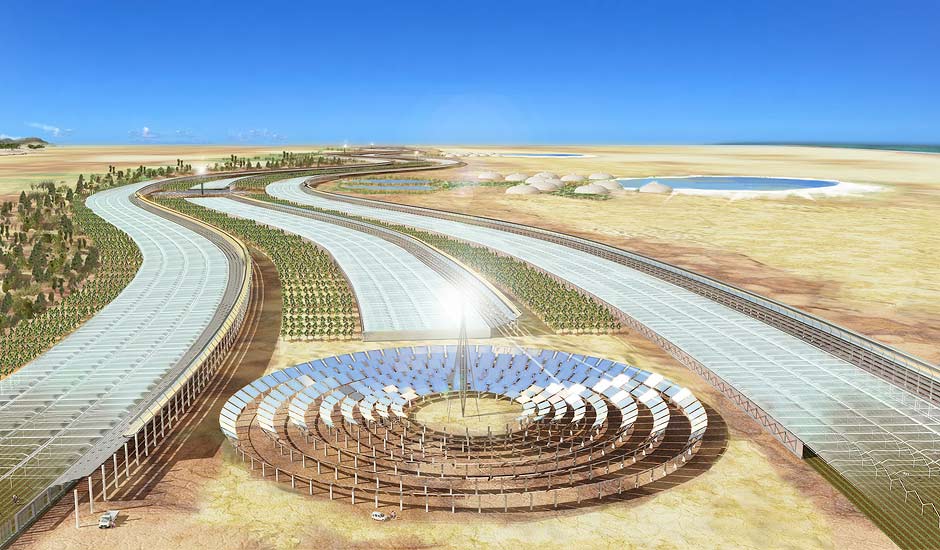
The Sahara forest
project will use seawater and solar power to grow food in greenhouses
across the desert. Photograph: Exploration Architecture
Vast greenhouses that use sea water for crop cultivation could
be combined with solar power plants to provide food, fresh water and
clean energy in deserts, under an ambitious proposal from a team of
architects and engineers.
The Sahara Forest Project, which is already running demonstration plants in Tenerife, Oman and the United Arab Emirates, envisages huge greenhouses with concentrated solar power (CSP), a technology that uses mirrors to focus the sun's rays, creating steam to drive turbines to generate electricity.
The installations would turn deserts into lush patches of vegetation, according to its designers, and do away with the need to dig wells for fresh water, an activity that has depleted aquifers across the world.
Charlie Paton, a member of the team, and the inventor of the Seawater Greenhouse, said the scheme was a proven way to transform arid environments. "Plants need light for growth but they don't like heat beyond a certain point," he said.
Above certain temperatures the amount of water lost through leaves' stomata rises so much plants stop their photosynthesis and do not grow. The solar farm planned by the project runs seawater evaporators, pumping damp, cool air through the greenhouses. This reduces the warmth inside by about 15C, compared with the temperature outside.
At the other end of the greenhouse from the evaporators, water vapour is condensed. Some of this fresh water is used to water the crops, some for cleaning the solar mirrors.
"So we've got conditions in the greenhouse of high humidity and lower temperature," said Paton. "The crops sitting in this slightly steamy, humid condition can grow fantastically well."
The designers said that virtually any vegetables could be grown in the greenhouses. The demonstration plants already produce lettuces, peppers, cucumbers and tomatoes. The nutrients to grow the plants could come from local seaweed or be extracted from the seawater.
Michael Pawlyn, of Exploration Architecture, based in London, worked on the Eden Project for seven years and is now part of the Sahara Forest team. He said that the Seawater Greenhouse and CSP provided substantial synergies for each other. "Both technologies work extremely well in hot, dry, desert locations. CSP produces a lot of waste heat and we'd be able to use that to evaporate more seawater from the greenhouse. And CSP needs a supply of clean, de-mineralised water in order for the [electricity generating] turbines to function and to keep the mirrors at peak output. It just so happens the Seawater Greenhouse produces large quantities of this."
Paton said the greenhouse produced more than five times the fresh water needed to water the plants inside, so some of the water could be released to the outside, creating a microclimate for hardier plants such as jatropha, a crop that can be turned into biofuel.
The cost of the Sahara Forest Project could be relatively low as both CSP and Seawater Greenhouses are proven technologies. The designers estimate that building 20 hectares (nearly 50 acres) of greenhouses combined with a 10MW CSP scheme would cost about €80m (£65m).
Paton said groups in countries across the Middle East, including in UAE, Oman, Bahrain, Qatar and Kuwait, have expressed interest in possibly funding demonstration projects.
He said use of Seawater Greenhouses could reverse the environmental damage done by the glasshouses already built in places such as the desert region of Almeria, southern Spain, where, constructed over the past 20 years to grow salad crops, they now covered more than 40,000 hectares.
Paton said: "They take water out of the ground something like five times faster than it comes in, so the water table drops and becomes more saline. The whole of Spain is being sucked dry. If one were to convert them all to the Seawater Greenhouse concept it would turn an unsustainable solution into a more sustainable one."
Pawlyn said: "In places like Oman they've effectively sterilised large areas of land by using groundwater that's become increasingly saline. The beauty of the Sahara Forest scheme is that you can reverse that process and turn barren land into biologically productive land."
Neil Crumpton, an energy specialist at Friends of the Earth, said the potential of these desert technologies was huge. "Concentrated solar power mirror arrays covering just 1% of the Earth's deserts could supply a fifth of all current global energy consumption. And 1 million tonnes of sea water could be evaporated every day from just 20,000ha of greenhouses."
Governments should invest in the technologies and "not be distracted by lobbyists promoting dangerous nuclear power or nuclear-powered desalination schemes", Crumpton added.
The International Energy Agency estimates that the world needs to invest more than $45 trillion (£22.5 trillion) in new energy systems over the next 30 years.
The Sahara Forest Project, which is already running demonstration plants in Tenerife, Oman and the United Arab Emirates, envisages huge greenhouses with concentrated solar power (CSP), a technology that uses mirrors to focus the sun's rays, creating steam to drive turbines to generate electricity.
The installations would turn deserts into lush patches of vegetation, according to its designers, and do away with the need to dig wells for fresh water, an activity that has depleted aquifers across the world.
Charlie Paton, a member of the team, and the inventor of the Seawater Greenhouse, said the scheme was a proven way to transform arid environments. "Plants need light for growth but they don't like heat beyond a certain point," he said.
Above certain temperatures the amount of water lost through leaves' stomata rises so much plants stop their photosynthesis and do not grow. The solar farm planned by the project runs seawater evaporators, pumping damp, cool air through the greenhouses. This reduces the warmth inside by about 15C, compared with the temperature outside.
At the other end of the greenhouse from the evaporators, water vapour is condensed. Some of this fresh water is used to water the crops, some for cleaning the solar mirrors.
"So we've got conditions in the greenhouse of high humidity and lower temperature," said Paton. "The crops sitting in this slightly steamy, humid condition can grow fantastically well."
The designers said that virtually any vegetables could be grown in the greenhouses. The demonstration plants already produce lettuces, peppers, cucumbers and tomatoes. The nutrients to grow the plants could come from local seaweed or be extracted from the seawater.
Michael Pawlyn, of Exploration Architecture, based in London, worked on the Eden Project for seven years and is now part of the Sahara Forest team. He said that the Seawater Greenhouse and CSP provided substantial synergies for each other. "Both technologies work extremely well in hot, dry, desert locations. CSP produces a lot of waste heat and we'd be able to use that to evaporate more seawater from the greenhouse. And CSP needs a supply of clean, de-mineralised water in order for the [electricity generating] turbines to function and to keep the mirrors at peak output. It just so happens the Seawater Greenhouse produces large quantities of this."
Paton said the greenhouse produced more than five times the fresh water needed to water the plants inside, so some of the water could be released to the outside, creating a microclimate for hardier plants such as jatropha, a crop that can be turned into biofuel.
The cost of the Sahara Forest Project could be relatively low as both CSP and Seawater Greenhouses are proven technologies. The designers estimate that building 20 hectares (nearly 50 acres) of greenhouses combined with a 10MW CSP scheme would cost about €80m (£65m).
Paton said groups in countries across the Middle East, including in UAE, Oman, Bahrain, Qatar and Kuwait, have expressed interest in possibly funding demonstration projects.
He said use of Seawater Greenhouses could reverse the environmental damage done by the glasshouses already built in places such as the desert region of Almeria, southern Spain, where, constructed over the past 20 years to grow salad crops, they now covered more than 40,000 hectares.
Paton said: "They take water out of the ground something like five times faster than it comes in, so the water table drops and becomes more saline. The whole of Spain is being sucked dry. If one were to convert them all to the Seawater Greenhouse concept it would turn an unsustainable solution into a more sustainable one."
Pawlyn said: "In places like Oman they've effectively sterilised large areas of land by using groundwater that's become increasingly saline. The beauty of the Sahara Forest scheme is that you can reverse that process and turn barren land into biologically productive land."
Neil Crumpton, an energy specialist at Friends of the Earth, said the potential of these desert technologies was huge. "Concentrated solar power mirror arrays covering just 1% of the Earth's deserts could supply a fifth of all current global energy consumption. And 1 million tonnes of sea water could be evaporated every day from just 20,000ha of greenhouses."
Governments should invest in the technologies and "not be distracted by lobbyists promoting dangerous nuclear power or nuclear-powered desalination schemes", Crumpton added.
The International Energy Agency estimates that the world needs to invest more than $45 trillion (£22.5 trillion) in new energy systems over the next 30 years.


