
Way to suppress appetite found

RELATED
WASHINGTON: Scientists have used genetic engineering
to identify a population of neurons that tell the brain to shut off
appetite. Researchers have also identified neurons in other brain
regions that can stimulate the appetite of mice that are not hungry,
paving way for therapies that promote or decrease appetite.
To identify these neurons, or cells that process and transmit information in the brain, researchers at the University of Washington first considered what makes an animal lose its appetite. There are a number of natural reasons, including infection, nausea , pain or simply having eaten too much already.
Nerves within the gut that are distressed or insulted send information to the brain through the vagus nerve.
Appetite is suppressed when these messages activate specific neurons - ones that contain CGRP, (calcitonin gene-related peptide) in a region of the brain called the parabrachial nucleus . In mouse trials, researchers used genetic techniques and viruses to introduce light-activatable proteins into CGRP neurons.
Activation of these proteins excites the cells to transmit chemical signals to other regions of the brain.
When they activated the CGRP neurons with a laser, the hungry mice immediately lost their appetite and walked away from their liquid diet (Ensure); when the laser was turned off, the mice resumed drinking the liquid diet. "These results demonstrate that activation of the CGRP-expressing neurons regulates appetite. This is a nice example of how the brain responds to unfavourable conditions in the body, such as nausea caused by food poisoning," said Richard Palmiter , UW professor of biochemistry and investigator of the Howard Hughes Medical Institute.
Using a similar approach, neurons in other brain regions have been identified that can stimulate the appetite of mice that are not hungry.
Researchers hope to identify the complete neural circuit in the brain that regulates feeding behaviour.
To identify these neurons, or cells that process and transmit information in the brain, researchers at the University of Washington first considered what makes an animal lose its appetite. There are a number of natural reasons, including infection, nausea , pain or simply having eaten too much already.
Nerves within the gut that are distressed or insulted send information to the brain through the vagus nerve.
Appetite is suppressed when these messages activate specific neurons - ones that contain CGRP, (calcitonin gene-related peptide) in a region of the brain called the parabrachial nucleus . In mouse trials, researchers used genetic techniques and viruses to introduce light-activatable proteins into CGRP neurons.
Activation of these proteins excites the cells to transmit chemical signals to other regions of the brain.
When they activated the CGRP neurons with a laser, the hungry mice immediately lost their appetite and walked away from their liquid diet (Ensure); when the laser was turned off, the mice resumed drinking the liquid diet. "These results demonstrate that activation of the CGRP-expressing neurons regulates appetite. This is a nice example of how the brain responds to unfavourable conditions in the body, such as nausea caused by food poisoning," said Richard Palmiter , UW professor of biochemistry and investigator of the Howard Hughes Medical Institute.
Using a similar approach, neurons in other brain regions have been identified that can stimulate the appetite of mice that are not hungry.
Researchers hope to identify the complete neural circuit in the brain that regulates feeding behaviour.
First computer programmer inspires women in technology
 A
A
A
RELATED
In 1842, Ada Lovelace, known as the "enchantress of numbers," wrote the first computer program.
Fast-forward 171 years to October 15 (which happened to be Ada Lovelace Day, for highlighting women in science, technology, engineering and math), and computer programming is dominated by men. Women software developers earn 80% of what men with the same jobs earn. Just 18% of computer science degrees are awarded to women, down from 37% in 1985. Fewer than 5% of venture-backed tech start-ups are founded by women.
Those statistics, released by Symantec, the security company, and the Anita Borg Institute, which works to recruit and promote women in tech, provide context for recent debates in Silicon Valley, like why Twitter has no women on its board.
Given that girls begin to shy away from computer science when they are young, because of a lack of role models and encouragement from parents and teachers, perhaps a short history lesson on Lovelace would be helpful.
She was the daughter of Lord Byron, the poet, who split from her mother shortly after her birth. Her mother encouraged her to pursue math to counter her father's "dangerous poetic tendencies," according to the University of California, San Diego.
Meanwhile, in Silicon Valley, some people sense change in the air. "There's a lot more focus than we've seen in the past, and a lot more hard conversations," said Telle Whitney, chief executive of the Anita Borg Institute . The Symantec and Anita Borg report tried to find a bright side — the wage gap is smaller in technology and engineering than it is in other fields, and the job opportunities are many.
Astia, which offers programs for women tech entrepreneurs, announced on Tuesday a partnership with Google to expand its lunch series for introducing women founders to investors. And two scientists, sponsored by Brown University, are hosting a mass Wikipedia editing session for people to create and expand upon entries for women in science and technology.
Fast-forward 171 years to October 15 (which happened to be Ada Lovelace Day, for highlighting women in science, technology, engineering and math), and computer programming is dominated by men. Women software developers earn 80% of what men with the same jobs earn. Just 18% of computer science degrees are awarded to women, down from 37% in 1985. Fewer than 5% of venture-backed tech start-ups are founded by women.
Those statistics, released by Symantec, the security company, and the Anita Borg Institute, which works to recruit and promote women in tech, provide context for recent debates in Silicon Valley, like why Twitter has no women on its board.
Given that girls begin to shy away from computer science when they are young, because of a lack of role models and encouragement from parents and teachers, perhaps a short history lesson on Lovelace would be helpful.
She was the daughter of Lord Byron, the poet, who split from her mother shortly after her birth. Her mother encouraged her to pursue math to counter her father's "dangerous poetic tendencies," according to the University of California, San Diego.
Meanwhile, in Silicon Valley, some people sense change in the air. "There's a lot more focus than we've seen in the past, and a lot more hard conversations," said Telle Whitney, chief executive of the Anita Borg Institute . The Symantec and Anita Borg report tried to find a bright side — the wage gap is smaller in technology and engineering than it is in other fields, and the job opportunities are many.
Astia, which offers programs for women tech entrepreneurs, announced on Tuesday a partnership with Google to expand its lunch series for introducing women founders to investors. And two scientists, sponsored by Brown University, are hosting a mass Wikipedia editing session for people to create and expand upon entries for women in science and technology.
Ada Lovelace, computing countess: Celebrating the first lady of IT
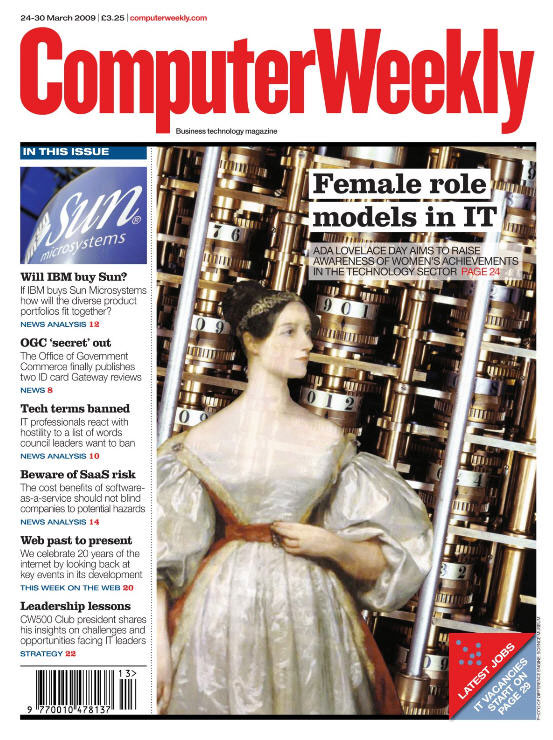
Today is Ada Lovelace day. Over 1,000 bloggers are uniting to celebrate the achievement of women in IT, under the sign of the world's first computer programmer, and daughter of Byron, Augusta Ada King, Countess of Lovelace.
We are supporting this effort as best we can. The UK IT profession is unarguably the poorer for the lack of women active in it.
In our feature on Ada Lovelace Day, Karen Price, chief executive of e-Skills makes the point that while just under half of pupils taking IT at GCSE level are female, only 15% of technology undergraduates are. Somewhere along the line, ability is being squandered.
We have also reported over the past few months that women are leaving the IT profession in significant numbers, despairing of family unfriendly working practices and a male-oriented monoculture in IT.
But this is not a day of lamentation. There are many women in IT doing creative work, and Rebecca Thomson's feature highlights five of them, including the founder of Girl Geeks, a networking group aimed at women in technology.
Moreover, the way the IT profession in developed economies like the UK's is evolving demands a suite of skills that includes - alongside deep enough technical knowledge - business relationship management capabilities, commercial awareness, and team communication. Not all women are rich in these so-called "softer" skills, just as not all men are bereft of them. Nonetheless, the tendencies are usually clear.
So, who was Ada Lovelace, and what did she do? By writing out a method for calculating Bernoulli numbers on Charles Babbage's analytical engine, now on display at the Science Museum in London, Lovelace was the first person to have programmed a computer.
She shared the spirit of scientific enquiry shown by Byron, her father, whose fascination, while at Cambridge, with telescopes and galvanism is well known. Byron's name is synonymous with European romanticism at its most revolutionary. His daughter's collaboration with Charles Babbage on the "thinking machine" puts her at the confluence of two radical phenomena: information technology and female emancipation.
Subscribe to:
Posts (Atom)