Why ISRO’s ASTROSAT launch is a big deal

India this week launched its first dedicated multi wavelength space observatory. Why is it a big deal?
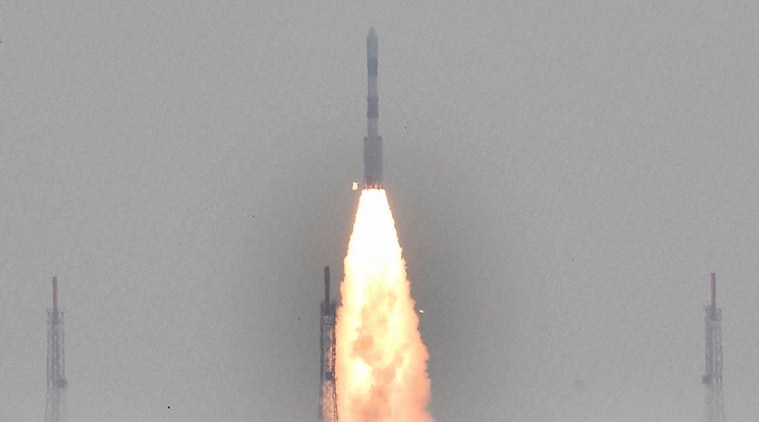
isro, Narendra Modi, ASTROSAT, isro sattellite, isro launch, isro news, astrosat launch, astrosat isro, astrosat india, India astrosat launch, astrosat launch india, india news, latest news Indian Space Research Organisation (ISRO)’s PSLV C 30 carrying India’s Multi Wavelength Space Observatory ASTROSAT, lifts off from Satish Dhawan Space Center in Sriharikota on Monday. (Source: PTI) WHY ASTROSAT
Electromagnetic radiation from space is distorted during passage through Earth’s atmosphere, hindering understanding of celestial objects. In 1946, American astrophysicist Lyman Spitzer had the idea of an observatory in space; his vision was realised with NASA’s launch of Hubble Space Telescope in 1990. European, Japanese and Russian space agencies followed with their space telescopes and, on September 28, the Indian Space Research Organisation (ISRO) put its own Astrosat in orbit
LONG IN THE MAKING
ISRO carried out a satellite-bound Indian X-ray Astronomy Experiment in 1996 and, in 2004, the space observatory was approved for development. Progress was slow as ISRO focussed on projects like heavy rocket launchers, communication satellites and deep space missions like Moon (2008) and Mars (2014). Decisions on instruments and studies of the observatory took long
Share This Article
Related Article
FIVE-POINT FOCUS
Astrosat is intended to
* Understand high-energy processes in binary star systems containing neutron stars and black holes
* Estimate magnetic fields of neutron stars
* Study star birth regions and high-energy processes in star systems beyond our galaxy
* Detect new, briefly bright X-ray sources
* Perform a limited deep field survey of the universe in the ultraviolet region
stsData collected by the five payloads will be transmitted to the Indian Space Science Data Centre (ISSDC) at Byalalu near Bengaluru; will be accessible to researchers at top astronomy institutions and universities
PARTNERS
Besides ISRO, the Tata Institute of Fundamental Research and Bhabha Atomic Research Centre, Mumbai; Indian Institute of Astrophysics and Raman Research Institute, Bengaluru; Inter-University Centre for Astronomy and Astrophysics, Pune; and S N Bose National Centre for Basic Sciences, Kolkata, were involved.

6-Month Mars Mission Will Now Last for 'Many Years'


Isro Says 6-Month Mars Mission Will Now Last for 'Many Years'

As it prepares to celebrate the first anniversary of its spacecraft's tryst with Mars, Isro Monday said the mission to the Red Planet will last for "many years" as there is not much of a "problem" and they have not had any failures so far.
"Mars (mission) is expected to last for many years now, because it has gone through solar conjunction also; so we don't see much of a problem," Isro Chairman AS Kiran Kumar told reporters in Bengaluru.
"We had planned it only for six months. Then we were not expecting so much fuel to remain after we completed our insertion activity," he said.
Pointing out that about 35kg of fuel was still left, he said, "There is still a lot of fuel... all other subsystems are working fine and so far we have not had any failures." Kiran Kumar was speaking on the sidelines of Prof Satish Dhawan Commemoration Lecture that was delivered by Dr K Radhakrishnan, a former chief of the Indian Space Research Organisation (Isro).
The event was organised by the Institution of Engineers (India)'s Karnataka state centre in Bengaluru. Scripting space history, India on September 24, 2014, had successfully placed its low-cost Mars spacecraft in orbit around the Red Planet on its very first attempt, breaking into an elite club of three nations.
Isro will mark the first anniversary of Mars Orbit Insertion by releasing an atlas containing photos taken by the colour camera on board the spacecraft.
"Currently, on September 24, we will be releasing one of the atlases - the on taking images of Mars Colour Camera and also some results from the Methane Sensor.... then, on November 5, we are bringing out a book, 'Fishing hamlet to Mars'," Kiran Kumar said.
Isro had launched the Mars Orbiter Mission's spacecraft on its nine-month-long odyssey on a homegrown PSLV rocket from Sriharikota in Andhra Pradesh on November 5, 2013, and it had escaped the earth's gravitational field on December 1, 2013.
Asked whether the extension in MOM's life will reflect in the planning for fuel consumption in upcoming projects, Kiran Kumar said, "No, that cannot be said as there is always a contingency. In this particular case, it went through without any such contingency. In another mission, it could be very different."
The Mars spacecraft's life was extended for another six months in March due to surplus fuel, which Isro now says can last for many years.
After India's much-hailed missions to the Moon and Mars that boosted Isro's global standing in space technology, the next inter-planetary expedition to be launched is under discussion.
"Currently, next inter-planetary mission discussions are going on; studies are in progress. We have to go through the discussions, and then the cost," he said.
Asked whether the discussions are focused on any specific planet, he said, "No. That has to be decided based on the outcome of the study."
Stating that Astrosat, a satellite for the first dedicated Indian astronomy mission aimed at studying celestial objects, is scheduled for launch on September 28, Kiran Kumar said, "What it means for India is this: it is one of the first scientific missions which will be available to the Indian researcher community as an observation opportunity."
Astrosat will be accompanied by six co-passengers - one satellite each from Indonesia and Canada, and four nano satellites from the US.
Isro is also working with the US on Nasa-Isro Synthetic Aperture Radar for a 2021 launch.

Nasa seeks students' ideas to land cargo on Mars

Livemint - ‎5 hours ago‎
Nasa is addressing the Mars challenge through the development of large aeroshells that can provide enough aerodynamic drag to decelerate and deliver larger payloads.

NASA's space shotgun to blast asteroids

Times of India - ‎5 hours ago‎