Gravitational Graviations>China observatory near Actual Control with India

China coming up with USD 18.8 million Gravitational waves observatory near Actual Control with India

China will set up world's highest altitude gravitational wave telescopes with a budget of USD 18.8 million close to the Actual Control with India.


By   |  Updated On : January 09, 2017 12:32 PM
China building world's highest altitude gravitational waves observatory in Tibet (Representational Pic)

China building world's highest altitude gravitational waves observatory in Tibet (Representational Pic)

Beijing :   Scientists have been trying to unearth the mysteries of the Big Bang and the birth of the universe. In order to know more about the Big Bang theory and in a bid to detect faintest echoes resonating from the universe, China is coming up with gravitational wave telescopes in Tibet.
The highest altitude gravitational wave telescopes in the world with a budget of USD 18.8 million will be set up close to the Actual Control with India.
The first telescope is already under-construction and has been code-named Ngari No 1, said Yao Yongqiang, chief researcher with the National Astronomical Observatories of the Chinese Academy of Sciences. Yongqiang further said that the first telescope is being set up 30 km south of Shiquanhe Town in Ngari Prefecture.
Parts of Nagri is last Tibetan prefecture at China's border with India.
The first telescope is located 5,250 meters above the level of the sea. It will detect and collect precise data on primordial gravitational waves in the Northern Hemisphere.
The telescope is likely to go operational by 2021, state-run Xinhua news agency reported.
In the second phase, a series of telescopes, code-named Ngari No 2 will be located about 6,000 meters above the level of the sea, said Yongqiang.
Yongqiang didn't spoke as to when will the construction of Ngari No 2 begin. There will be only two phases of Ngari gravitational wave observatory the estimated budget for which has been set up at 130 million yuan (USD 18.8 million).
The Institute of High Energy Physics, National Astronomical Observatories, and Shanghai Institute of Microsystem and Information Technology, among others initiated the project, the report said.
Ngari sports high altitude, clear sky and minimal human activity. It is said to be one of the best spots in the world to detect tiny twists in cosmic light.
Yao said the Ngari observatory will be among the world's top primordial gravitational wave observation bases, alongside the South Pole Telescope and the facility in Chile's Atacama Desert.
Albert Einstein's theory of general relativity first proposed the gravitational waves 100 years ago. But it wasn't until 2016 that scientists with the Laser Interferometer Gravitational-Wave Observatory announced proof of the waves' existence, spurring fresh research interest among the world's scientists.
Last September, China commissioned the world's largest radio telescope in a mountainous region of southwest China's Guizhou Province to search for more strange objects space, gain better understand the origin of the universe and to boost the global hunt for extraterrestrial life.
The installation of the telescope's main structure -- a 4,450-panel reflector as large as 30 football pitches was built at unique valley in Guizhou Province.
(With inputs from PTI)

LOST IN TRANSIT[BLACK MATTER]time to question the maker cum supplier

Scientists discover dark matter lost since birth of universe

By Zee Media Bureau | Last Updated: Saturday, December 31, 2016 - 08:24
 Scientists discover dark matter lost since birth of universe
Moscow: Scientists, for the first time, have been able to measure the amount of dark matter the Universe has lost since the Big Bang some 13.7 billion years ago.
About five per cent of the elusive dark matter in the universe has been lost till now, they calculated.
The finding is also likely to explain one of the biggest mysteries in physics - why our Universe appears to function in a slightly different way than it did in the years just after the Big Bang. It could also explain the origin of dark matter and how it might evolve or decay in future.
The study could also help astrophysicists explain how the universe has changed over time. The findings may show how the universe's rate of expansion has varied and what happened in the universe's first few hundred thousand years.
Most of the matter in the universe seems to be invisible and largely intangible; it holds galaxies together and only interacts with the more familiar matter hrough its gravitational pull.
"The discrepancy between the cosmological parameters in the modern Universe and the Universe shortly after the Big Bang can be explained by the fact that the proportion of dark matter has decreased," Igor Tkachev, head of the of the Department of Experimental Physics at the Institute for Nuclear Research in Russia told PTI.
"We have now, for the first time, been able to calculate how much dark matter could have been lost and what the corresponding size of the unstable component would be," Tkachev said.
Their study suggests that no more than 5 percent of the current amount of dark matter in the universe, could have been lost since the Big Bang.
According to data from the  European Space Agency (ESA)’s Planck space telescope, the proportion of dark matter in the universe is 26.8 per cent, the rest is “ordinary” matter (4.9 per cent) and dark energy (68.3 per cent).
The properties of dark matter could potentially help scientists solve the problem that arose after studying observations from the Planck telescope.
This device accurately measured the fluctuations in the temperature of the cosmic microwave background radiation – the “echo” of the Big Bang.
By measuring these fluctuations, researchers were able to calculate key cosmological parameters using observations of the universe in the recombination era – about 300,000 years after the Big Bang.
But even though the majority of matter predicted to be in the Universe is actually dark, little is known about dark matter - in fact, scientists till now haven't been able to prove that it actually exists.
(With PTI inputs)
Image result for CONFUSED GODRelated image


Movie/Album: Maut Ki Sazaa (1991)
Singers: Anup Jalota
Lyricist: Maya Govind
Song Type/Mood: Sad
Music Composer: Anup Jalota
Music Director: Anup Jalota
comment:-
who said he is not a joker also ?


“The technology saved lives,

Berlin attack: Lorry's automatic braking system stopped more deaths during the Christmas market assault

Investigators find system stopped Anis Amri continuing rampage that killed 12
An automatic braking system fitted to the lorry used in the Berlin attack may have prevented the deaths of many more victims, investigators have found.
Anis Amri, a Tunisian Isis supporter, is believed to have hijacked the vehicle from its Polish driver in the German capital before ploughing it into a busy Christmas market on 19 December.
Eleven people were killed and more than 50 others injured, being caught under the wheels or crushed by debris before the lorry came to a stop.
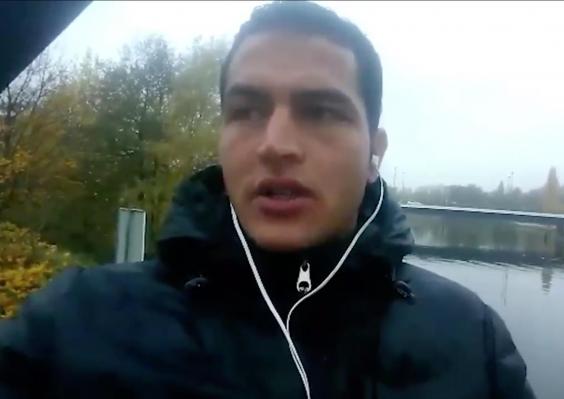
Video surfaces of Berlin attack suspect Anis Amri
Investigators now believe the driver was only able to push a maximum of 260ft (80m) into the market because of the vehicle’s emergency braking system.
It kicked in after detecting obstacles and no response from the cab, bringing the lorry to a stop as quickly as possible given its forward momentum.
“The technology saved lives,” a Berlin local government official told the Süddeutsche Zeitung.
An older lorry used in the Nice attack was not equipped with the system, allowing Isis supporter Mohamed Lahouaiej-Bouhlel to kill 86 people and injure 400 more after driving into densely packed crowds celebrating Bastille Day. 
His rampage lasted at least five minutes, while the Berlin attack happened in a matter of seconds after the lorry accelerated off a main road next to the Christmas market on Breitscheidplatz, according to witnesses.
There was initial speculation the lorry’s driver, Lukasz Urban, may have fought the hijacker in an attempt to prevent the attack but a post-mortem found he had been shot in the head at least two-and-a-half hours before and would have been unable to intervene.
The hijacker fled the scene and was later identified as Amri, whose wallet, identification, phone and fingerprints were found at the crime scene.
Minutes before the attack, he reportedly sent a message reading:  “My brother, all is well, according to God's will. I am now in a car, pray for me my brother, pray for me.“ 
It was sent along with a selfie taken in the lorry’s cab to a contact, who remains unidentified after 40-year-old Tunisian man who arrested in Berlin was freed.
“Brother” is frequently used to address other Muslims, rather than exclusively relatives.
Amri was shot dead in a gun battle with Italian police in Milan on Friday after days on the run as the most wanted man in Europe.
The 24-year-old Tunisian man had a lengthy criminal history, including armed robbery in his home country and arson in Italy, where he was jailed for four years after arriving in Europe by boat in 2011.
Italian authorities attempted to deport Amri after he finished serving his prison sentence in 2015 but Tunisia refused to take him and he was released from a detention centre after the 60-day legal limit.
Amri’s brothers believe he was radicalised during his imprisonment, travelling onwards to Germany where he became part of an Islamist network including two hate preachers in Dortmund and Hildesheim who have since been jailed for supporting Isis.
Having flagged as a terror risk, he was put under surveillance over a separate attack plot in March but the investigation stopped in September after uncovering drug dealing and minor crime but failing to reveal evidence of extremism.
anis-amri-video-isis.jpg
Berlin attack suspect Anis Amri pledged allegiance to Isis in a video released by the group following his death
Security services rated Amri as a “five” on an eight-point danger scale and did not believe an attack was likely, Süddeutsche Zeitung reported, despite having evidence he volunteered to commit a suicide bombing and researched making explosives, and updating his file just five days before the Berlin attack.
Amri’s asylum application was denied in June but Germany was unable to deport him because Tunisia refused to accept the expulsion without documents proving his nationality.
Prosecutors in North Rhine-Westphalia also opened a fraud investigation after Amri was suspected using two of at least eight identities he employed in Germany to claim refugee benefits in two towns.
Detlef Nowotsch, a spokesman for prosecutors in Duisburg, told The Independent Amri applied for public funds in both Emmerich and Oberhausen in late 2015. But an investigation started in April was shelved in November because his whereabouts were unknown.
Authorities across Europe are attempting to piece Amri’s movements together through Germany, and then on his route via the Netherlands and France to Italy as he fled following the attack.
Italian police have searched three houses in and around Rome where he may have stayed after leaving a detention centre in Sicily in 2015.
Investigators are trying to establish whether Amri was attempting to reach another country when he was shot in Milan or seeking shelter with contacts in the city. 
EU nations have vowed to work to increase security cooperation, while Angela Merkel ordered a sweeping security review to identify any necessary reforms in Germany.