Criminals
are always looking for new ways to rip us off. Whether it's ransomware,
phishing attacks or ATM skimmers, we constantly need to be on the
lookout to stay protected.
Researchers have discovered
that covering your hand while typing in your PIN code isn't a secure
enough procedure. That's because some high-tech thieves are using
thermal cameras to steal your PIN.
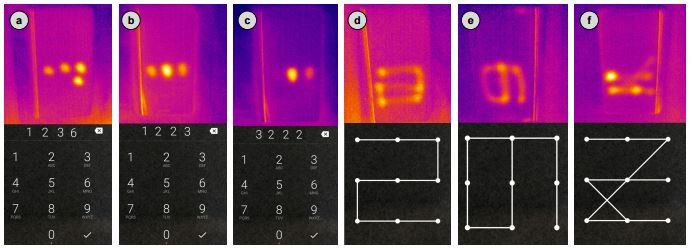
How this works is, once you
type in your PIN code, a thief can take a picture of the heat marks left
behind on the screen with a thermal camera. They are then able to
figure out the order that you typed the numbers in by the strength of
the heat marks. The last number you enter will show up stronger and the
first number will be lighter.
Image: Example of how criminals can steal your PIN using thermal cameras. (Source: University of Stuttgart)
This
doesn't only expose the PIN code to unlock your phone either. Thieves
can use this technique anywhere you type your credit or debit card PIN,
such as a grocery store, gas station or ATM.
Researchers at the
University of Stuttgart studied this technique of stealing PIN codes.
They found that they were able to successfully decipher a users' PIN 90
percent of the time if the thermal image was captured in 15 seconds or
less from the time the PIN was entered.
It's even worse for
Android users. The researchers were able to figure out the correct
pattern 100 percent of the time for those who use a finger-drawn pattern
code. They even had more time to take the thermal image, up to 30
seconds after the pattern was drawn.
Watch the following video from a YouTuber demonstrating how simple it is for a thief to take a thermal image of a PIN.
How thieves can steal your PIN
Researchers have discovered
that covering your hand while typing in your PIN code isn't a secure
enough procedure. That's because some high-tech thieves are using
thermal cameras to steal your PIN.
How this works is, once you
type in your PIN code, a thief can take a picture of the heat marks left
behind on the screen with a thermal camera. They are then able to
figure out the order that you typed the numbers in by the strength of
the heat marks. The last number you enter will show up stronger and the
first number will be lighter.
Image: Example of how criminals can steal your PIN using thermal cameras. (Source: University of Stuttgart)
This
doesn't only expose the PIN code to unlock your phone either. Thieves
can use this technique anywhere you type your credit or debit card PIN,
such as a grocery store, gas station or ATM.
Researchers at the
University of Stuttgart studied this technique of stealing PIN codes.
They found that they were able to successfully decipher a users' PIN 90
percent of the time if the thermal image was captured in 15 seconds or
less from the time the PIN was entered.
It's even worse for
Android users. The researchers were able to figure out the correct
pattern 100 percent of the time for those who use a finger-drawn pattern
code. They even had more time to take the thermal image, up to 30
seconds after the pattern was drawn.
Watch the following video from a YouTuber demonstrating how simple it is for a thief to take a thermal image of a PIN.
How to protect your PIN code
The researchers that discovered
this PIN stealing possibility have a very simple solution to stop
thieves from getting your code. Here are their suggestions:
Smartphone - Simply place your hand on the display screen after entering your PIN. This should remove all thermal traces.
Point-of-sale (POS)
- When typing your PIN at locations such as a grocery store, gas
station or ATM, place a few fingers on buttons that are not part of your
code. Hold them there while you type your PIN in and leave them there
for a few seconds after. This should make the digits that show up on an
infrared picture useless to the scammer. They will not be able to figure
out which buttons are actually part of the PIN and which were decoys.
Having a thief steal your PIN code by itself isn't a great danger to you. However, if they have installed a skimmer on a POS and get your PIN, your bank account is in serious trouble.
If
it's the PIN to your phone, the thief would need to get their hands on
it to cause problems. This is why you should never leave your gadget
where someone can take it without your knowledge. Don't leave it on your
desk at work, or anywhere for that matter, if you need to leave the
room for any purpose.
Electronic Voting Machines ("EVM") are being used in Indian General and State Elections to ... An EVM consists of two units, control unit and balloting unit.
Mar 27, 2009 - CIA Warning: 'E-Voting Not Secure' - U.S. EAC Finally Releases Complete ... of his complete control of the voting machines and their infrastructure, that .... machines can be interrogated electronically remotely on Election Day.
Apr 1, 2012 - India's Electronic Voting Machines (EVMs) have two main components (1) ... The system is powered by a battery pack inside the control unit.
Feb 11, 2017 - The voting machines used in India are a combination of two components. ... the election process is not hindered even in the remote areas of the ... The results acquired by an EVM's control unit are not transmitted electronically.
Ans. An Electronic Voting Machine consists of two Units – a Control Unit and a Balloting Unit – joined by a five-meter cable. The Control Unit is with the Presiding ...
Apr 29, 2010 - In this paper, we present a security analysis of a real Indian EVM .... off, and the control unit emits a loud beep to indicate that the vote has been cast. ..... Our solution is to keep the radio off until the display is blank, as it is ...
Jul 21, 2015 - Indian Scenario. Various Stages ... Electronic Voting Machines (EVM) ... Remote control of client computer (Open source Back Orifice 2000).
When was the EVM introduced in India? ... register of voters in Form 17-A. The display system of the control unit shows the total .... is a stand alone machine which can not be connected to any network and controlled through network or remote.
3 days ago - Discussing the CIA's Remote Devices Branch's UMBRAGE group, Wikileaks' ... Wikileaks claims that the CIA lost control of the majority of its hacking .... parties and candidates in the lead up to the 2012 presidential election.
3 days ago - WikiLeaks documents reveal CIA agents were given cover identities and diplomatic ... day' exploits, malware remote control systems and associated documentation." ... Experts warn of election cyberattacks threat in Germany.
4 days ago - WikiLeaks claims the CIA has software that enables it to bypass encrypted ... CIA has been trying to be able to remotely control vehicles so they could .... May lost an important vote in the House of Lords which voted to give the ...
4 days ago - THE CIA looked at developing a system that could potentially assassinate vehicle drivers remotely by 'infecting vehicle control systems', the Wikileaks organisation ... Will Trump pardon Assange after WikiLeaks election help?
4 days ago - The related portion of WikiLeaks' official press release on the leak reads: ... #CIA has tools to remote control chips in cars, trucks, planes ...
4 days ago - Explosively, WikiLeaks also claims that the CIA has lost control of their ... malware remote control systems and associated documentation.
4 days ago - According to the WikiLeaks, dump, the CIA has lost control of much of its ... malware remote control systems and associated documentation.
3 days ago - What we know about car hacking, the CIA and those WikiLeaks claims ... taking control of the device remotely and amplifying its signal, Wired ...
4 days ago - Wikileaks: CIA Explored Car Hacking to Carry Out “Undetectable ... “As of October 2014 the CIA was also looking at infecting the vehicle control systems used by modern .... I never again will vote for a career politicians unless its someone ... It may not be able to be fully steered and controlled via remote, but ...
Nov 5, 2012 - A simple non-cyber attack on an electronic voting machine ... If you wanted a deluxe version where you can control it remotely from a half a mile ..
Sep 28, 2011 - E-voting machines vulnerable to remote vote changing ... electronically, the remote hijacker could use a Radio Frequency remote control to ...
Electronic Voting Machines ("EVM") are being used in Indian General and State Elections to ... An EVM consists of two units, control unit and balloting unit.
Apr 1, 2012 - India's Electronic Voting Machines (EVMs) have two main components (1) ... The system is powered by a battery pack inside the control unit.
Feb 11, 2017 - The voting machines used in India are a combination of two components. ... the election process is not hindered even in the remote areas of the ... The results acquired by an EVM's control unit are not transmitted electronically.
Ans. An Electronic Voting Machine consists of two Units – a Control Unit and a Balloting Unit – joined by a five-meter cable. The Control Unit is with the Presiding ...
Apr 29, 2010 - In this paper, we present a security analysis of a real Indian EVM .... off, and the control unit emits a loud beep to indicate that the vote has been cast. ..... Our solution is to keep the radio off until the display is blank, as it is ...
Jul 21, 2015 - Indian Scenario. Various Stages ... Electronic Voting Machines (EVM) ... Remote control of client computer (Open source Back Orifice 2000).
When was the EVM introduced in India? ... register of voters in Form 17-A. The display system of the control unit shows the total .... is a stand alone machine which can not be connected to any network and controlled through network or remote."Man-in-the-Middle" Remote Attack on ...
This beautiful Hubble image reveals a young super star cluster
known as Westerlund 1, only 15,000 light-years away in our Milky Way
neighborhood, yet home to one of the largest stars ever discovered.
The idea of terraforming Mars – aka “Earth’s Twin” – is a
fascinating idea. Between melting the polar ice caps, slowly creating an
atmosphere, and then engineering the environment to have foliage,
rivers, and standing bodies of water, there’s enough there to inspire
just about anyone! But just how long would such an endeavor take, what
would it cost us, and is it really an effective use of our time and
energy?
These raw, unprocessed images of Saturn’s tiny moon, Pan, were
taken on March 7, 2017, by NASA’s Cassini spacecraft. The flyby had a
close-approach distance of 24,572 kilometers (15,268 miles).
Single-stage sounding rockets are used to transport scientific
equipment into, or just beyond, Earth’s atmosphere to measure phenomena
such as aurora. Recently, scientists have begun designing rockets with
hybrid engines, which work by alternating between different phases of
solid fuel and liquid or gas oxidizers. Hybrid rockets are cheaper,
safer and cleaner than those with conventional solid fuel engines.
Finding derelict spacecraft and space debris in Earth’s orbit can
be a technological challenge. Detecting these objects in orbit around
Earth’s moon is even more difficult. Optical telescopes are unable to
search for small objects hidden in the bright glare of the moon.
However, a new technological application of interplanetary radar
pioneered by scientists at NASA’s Jet Propulsion Laboratory in Pasadena,
California, has successfully located spacecraft orbiting the moon—one
active, and one dormant. This new technique could assist planners of
future moon missions.
On Earth, liquid flows downhill thanks to gravity. Creating an
effective liquid fuel tank involves little more than putting a hole at
the bottom of a container.
For the supermassive black hole at the center of our Milky Way
galaxy, it’s been a long time between dinners. NASA’s Hubble Space
Telescope has found that the black hole ate its last big meal about 6
million years ago, when it consumed a large clump of infalling gas.
After the meal, the engorged black hole burped out a colossal bubble of
gas weighing the equivalent of millions of suns, which now billows above
and below our galaxy’s center.
Every day, invisible magnetic explosions are happening around
Earth, on the surface of the sun and across the universe. These
explosions, known as magnetic reconnection, occur when magnetic field
lines cross, releasing stored magnetic energy. Such explosions are a key
way that clouds of charged particles—plasmas—are accelerated throughout
the universe. In Earth’s magnetosphere—the giant magnetic bubble
surrounding our planet—these magnetic reconnections can fling charged
particles toward Earth, triggering auroras.