Einstein made his share of errors. Here are three of the biggest
Lucky for us, he was a persistent sort.
by Dan Falk /
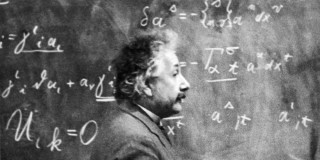
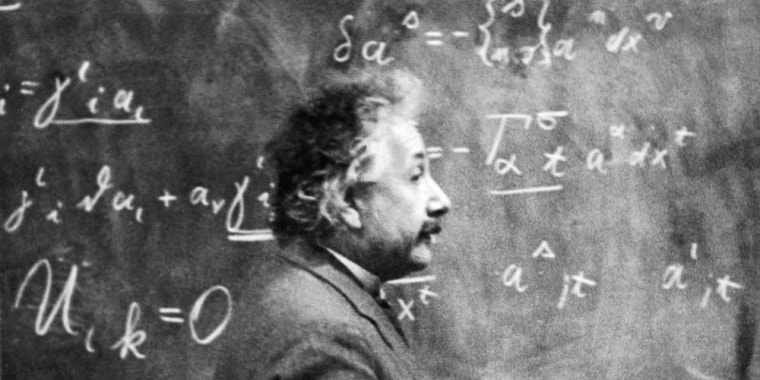
Physicist Albert Einstein stands beside a blackboard with mathematical calculations written across it in 1921.Hulton Archive via Getty Images
Get the Mach newsletter.
Even
people who know little about Albert Einstein’s work know he was
brilliant — so clever that his name is synonymous with genius. Of
course, the mind that gave us the theory of general relativity, the 1915 masterwork that sealed Einstein’s scientific reputation, was human. And so Einstein made his share of mistakes.
Here’s a close look at three times the great physicist, born on Pi Day (March 14) 139 years ago today, got things wrong.
1. Starlight bends — but how much?
Place
a heavy ball on a sheet of rubber, and the ball's weight distorts the
sheet. Einstein realized that something similar happens in space:
Gravity from stars and other massive objects bends the paths of nearby
light rays. If a ray of light from a distant star passes the sun on its
way to Earth, for example, it should bend enough to cause a tiny shift
in the observed position of the star.
It’s not easy to test this
idea. For one thing, the shift is truly minute. And the blinding light
of the sun can make distant stars hard to see. But astronomers realized
that even a tiny shift ought to be visible during a total solar eclipse,
when light from the sun is blotted out.
Einstein performed a
series of calculations to determine the size of the predicted shift but
initially muffed the effort, arriving at a number that was half the
correct value.
Had
the astronomers managed to test this number in their initial
eclipse-viewing efforts, their observations wouldn’t have matched his
prediction. But their attempts were stymied by weather in 1912 and by
war in 1914. By the time they made the necessary observation, in the spring of 1919, Einstein had corrected his blunder — and astronomers saw exactly the shift that he had predicted.
2. Gravitational waves don’t exist — or do they?
The discovery of gravitational waves
in 2016 was hailed as a triumph of Einstein’s theory, the confirmation
of a prediction made in 1916. But as you might suspect, there’s more to
the story.
Soon after developing general relativity, Einstein
began to wonder if there might be a wave associated with gravity as
there is with electromagnetism. (Electromagnetic waves include visible light as well as radio waves, microwaves, and X-rays.)
Einstein
moved on to other problems. When he returned to it two decades later,
he concluded that gravitational waves waves couldn’t exist because
they’d create “singularities” — regions in which space and time are
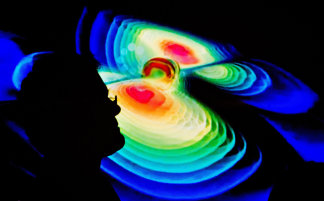
stretched to infinity. A
scientist is silhouetted against a visualization of gravitational waves
during a press conference by the Max Planck Institute for Gravitational
Physics (Albert Einstein Institute) at the Leibniz University in
Hanover, Germany, Thursday, Feb. 11, 2016. U JULIAN STRATENSCHULTE / EPABut
Einstein had goofed because of the mathematical coordinate system he
used to tackle the problem. It's a bit like what happens with the
latitude and longitude used to track positions on Earth, says University
of Arkansas physicist Daniel Kennefick. It works fine in most places on
the planet. But as one gets close to the poles, lines of longitude
converge and the system breaks down.
"It
doesn't mean the North Pole doesn't exist — it's a real place — it's
just that the coordinate system breaks down," Kennefick says.
Einstein
hadn't shown that gravitational waves couldn't exist, only that they
couldn't exist in the mathematical system that he'd used.
When Einstein submitted a paper arguing that gravitational waves don't exist to Physical Review, the journal’s editor sent it back to for revisions. Outraged, Einstein withdrew
it. By the time he submitted it to another journal, he had corrected
his mistake. The revised paper argued that gravitational waves do, in
fact, exist.
3. Einstein and the expanding universe
Einstein
was uncomfortable with some of relativity’s implications, including one
of the biggest — that the universe isn’t a static thing but an entity
that must expand or contract. This was unthinkable to Einstein, who
believed the universe existed in a “steady state.”
So Einstein added a fudge factor to his equations, a kind of energy associated with empty space. This cosmological constant
allowed for a stable universe. But sure enough, astronomers in the
1920s confirmed that the universe was expanding. Einstein later called
the cosmological constant the “greatest blunder” of his career.
Einstein's
resistance to the idea of an expanding universe makes sense in light of
his classical education, says Marcia Bartusiak, a science journalism
professor at MIT and the author of several books on the history of
physics. His schooling took place in the 1880s and 1890s, when the
prevailing wisdom — based on physics going back to the work of Isaac
Newton — was that the universe was static. An expanding cosmos simply
"didn't fit with his view of how the universe acted," she says. But when
astronomers showed Einstein the data, he came around.
“He listened to the evidence, from [astronomer Edwin] Hubble,” Bartusiak says. "He admitted his error.”
(In the late 1990s, astronomers discovered that the universe is not only expanding but expanding at an accelerating rate.
Now they wonder if something like Einstein’s cosmological constant is
playing a role — which means his earlier “mistake” may in fact have been
an idea ahead of its time.)
Einstein’s
errors take nothing away from his extraordinary achievements. Indeed,
they would hardly be noteworthy if they involved a lesser thinker. And
the fact that he didn’t let himself be derailed by his missteps — that
he changed course in light of new evidence — is a hallmark of his
brilliance, says historian Jürgen Renn.
“He persisted, in spite of
incredible obstacles, in spite of the errors,” says Renn, director of
the Max Planck Institute for the History of Science in Berlin. “And in
the end, he came up with one of the most revolutionary theories in all
of physics.”
Nov 7, 2017 - For
almost a century this underground railway was the main means of
communication for millions of people living in and around London.
Considered to be the social network of the 1900s, the underground Mail Rail was the equivalent of email and Facebook, connecting millions of Londoners daily via posta
May 7, 2001 - In
the bowels of New York City a century ago, not only was there the
whoosh of water through pipes and the whiz of subways through tunnels, there was ... In describing the system's effectiveness during a snowstorm, a 1914 congressional report of the Pneumatic Tube Postal Commission said: ''New York ...
Postal Museum, London: What it's like to ride London's hidden underground railway
The Rail Mail network sits 21 metres below the streets of London and stretches a distance of 10 kilometres.
Visitors can ride a section of the Rail Mail route at London's Postal Museum. Photo: Supplied
The Rail Mail network sits 21 metres below the streets of London stretching over 10 kilometres. Photo: Annie Dang
The Rail Mail network sits 21 metres below the streets of London stretching over 10 kilometres. Photo: Miles Willis
Riding the Rail Mail train at London's Postal Museum. Photo: Annie Dang
The Rail Mail network sits 21 metres below the streets of London stretching over 10 kilometres. Photo: Annie Dang
An old train that hasn't been moved from the railway since it closed. Photo: Annie Dang
An old train that hasn't been moved from the railway since it closed. Photo: Annie Dang
A stop by a train grave yard on Rail Mail ride at London's underground Postal Museum. Photo: Annie Dang
The Rail Mail network sits 21 metres below the streets of London stretching over 10 kilometres. Photo: Miles Willis
Riding the Rail Mail train at London's Postal Museum. Photo: Annie Dang
The Rail Mail network sits 21 metres below the streets of London stretching over 10 kilometres. Photo: Annie Dang
The Rail Mail network sits 21 metres below the streets of London stretching over 10 kilometres. Photo: Annie Dang
London's underground Postal Museum. Photo: Miles Willis
An old train on display at London's Postal Museum.
An old train on display at London's Postal Museum.
An old train on display at London's Postal Museum. Photo: Annie Dang
A tool box of a Rail Mail engineer display at London's Postal Museum. Photo: Supplied
An exhibition at London's Postal Museum. Photo: Annie Dang
Twenty-one metres below the streets of London, there is a
vast, sophisticated network of railway tunnels that stretches more than
10 kilometres.
For almost a century this underground railway was
the main means of communication for millions of people living in and
around London. Considered to be the social network of the 1900s, the
underground Mail Rail was the equivalent of email and Facebook,
connecting millions of Londoners daily via postal mail.
Unbeknown to many Londoners, the complex network of Mail Rail,
which operated from the 1920s until 2003, exists beneath today's London
underground. At its peak, the railway ran for 10.4 kilometres from
Paddington to Whitechapel and was made up of six sorting offices with a
mainline railway station. Running 22 hours a day, the railway
transported on average 4 million letters a day across the capital from
post box to the delivery address and it employed 220 staff.
Visitors
to central London's Postal Museum, which opened in late July this year,
can ride on one of the railway's driverless trains, a replica of the
historic trains that used to travel the railway. London's Mail Rail was
the world's first railway serviced by driverless electric trains. Its
introduction was hailed as a significant technological and communication
innovation for a city that was suffering serious delays in postage
delivery because of traffic congestion on London's streets. In those
days, the postal service operated twice daily, which meant that if you
sent mail in the morning, you could expect a reply by the afternoon. The
frequency may seem like "snail-mail" by today's email standards, but
its purpose and relevance as London's key method of communication,
business or personal, reveals the enormity and scale of Mail Rail's
operations.
A round-trip on the Mail Rail train, which started
running in early September, takes about 15 minutes and begins at what
used to be the Mount Pleasant depot. Each passenger gets a train car to
themselves; it's a rather compact space but big enough for one person.
My train is red and looks rather like a Lego toy. The train slowly pulls
out of the platform; picking up speed as it meanders around corners in
the low light and makes short stops along the way. The ride includes
montages and a story describes the railway's working life, from its
1930s heydays to World War II, as well as giving personal anecdotes from
people who worked on the railway.
The museum also features
several exhibitions at the same location. At the Mail Rail exhibition
retired trains and large rail equipment that was used to build and
maintain the railway are on display. The exhibition takes a closer look
at the engineering feats behind the inception and legacy of the railway.
The Postal Service exhibition features modern stamp designs, including
Penny Blacks, the world's first adhesive postage stamps, a selection of
retro posters and magazines from the 1950s and 60s, and post buses that
were used to deliver mail to remote or rural areas.
Jul 28, 2017 - The
Mail Rail's most recent rolling stock was built way back in 1980; it
didn't have any seats, nor was it really rated for human transportation
through some rather rough-looking tunnels. So, the Postal Museum—the charity that now operates the railway—commissioned some brand-new trains from Severn ...
An engraving of a similar system at Crystal Palace in 1864. Image: Wikimedia Commons.
Since the opening of the first underground railway in London over 150
years ago, we’ve settled on a mix of different ways for moving people
through cities: train, tram, bus, car, bike, bus, foot. Over the years,
though, major cities could afford to experiment with some pretty far-out
technologies.
So it is with the London Pneumatic Despatch Railway (LPDR), a Futurama-ish tube that carried parcels and people beneath the capital in the 1860s.
I first stumbled across the LPDR when reading up about pneumatic tubes after Elon Musk announced his Hyperloop idea. If
you missed it, he wants to send people in capsules through a 570km-long
pneumatic low-pressure tube from Los Angeles to San Francisco at speeds
of up to 962km/h (yeah, really).
I read that, then saw this:
Image: Royal Mail Group Ltd. 2013, courtesy British Postal Museum & Archive.
That's a party of Victorians gathered around a “pneumatic
despatch tube”, and they look like they're going to send those two men
through it in a carriage. What the hell was this thing?
To find out, I asked Julian Stray, the senior curator of the British Postal Museum & Archive (BPMA). The story begins in the middle of the 19th century, at the height of the British Empire. And it’s all about mail.
“The General Post Office (GPO) was the routing hub of the whole
country,” Stray explains. “You would have had the foreign mails, the
inland mails, the country mails, the mails to the provinces. Speed is
everything. A loss of two minutes required a written explanation to one
of the directors or the Postmaster General.”
The bandwidth of this system was throttled by the narrow streets
between the stations on London’s edge, and the GPO sorting office in the
middle near St Paul's Cathedral – horse and carriage traffic jams could
have Empire-wide knock-on effects. And, in an example of what Stray
calls “that Victorian endeavour, that willingness to have a go
regardless of the cost of failure”, some canny entrepreneurs spotted a
business opportunity.
A group of men came together to form the Pneumatic Despatch Company.
Its board was headed by the 3rd Duke of Buckingham, a close friend of
Disraeli’s. Also involved were bookstore magnate WH Smith (yes, that WH
Smith), and Thomas Brassey, an engineer who was one of the key players
in the Victorian era’s “railway mania”. They were going to build a new
kind of underground railway.
Image: Royal Mail Group Ltd. 2013, courtesy BPMA.
In the summer of 1861, Thames steamship passengers floating past
Battersea Pier would have seen a curious experiment laid out on the
river bank: 411m of cast-iron tunnel, 80cm tall and a little bit
narrower than that wide, with carriages disappearing into one end and
reappearing at the other. It was a pneumatic tube, big enough for bags
of mail – and people. Grinning
lads would climb into the carriages, lie under a blanket, and get fired
along the tube at speeds up to 30mph.
Pneumatic tubes are still around today, in places like hospitals and
banks. Most major cities in Europe and North America had their own
pneumatic telegraph networks in the latter half of the 19th century,
before the electrical telegraph took over – though some networks lasted for decades beyond then. François Truffaut’s 1969 film Baisers Volés features a scene with a character sending a letter via Paris’ still-operational pneumatic telegraph:
The modern pneumatic capsule system was invented by engineer William Murdoch
in the 1830s. These were tubes of a few inches in diameter, designed to
carry small, light items, like letters. Powered by a steam engine, they
worked on the principle of suck or blow (and that's not how Musk's
Hyperloop would work, by the way, which achieves its high speeds by
sucking the air out of the tube so there's minimal air resistance for
capsules riding on rails). It's a simple system, and inevitably some
engineers in the mid-19th century wanted to scale it up to something big
enough to carry people.
The most famous of these is probably Alfred Beach, whose 1870 Beach Pneumatic Transit was the first subway line in New York City (and which might be most famous now for its brief cameo in Ghostbusters).
A tube-shaped train that could carry 22 people sat flush within a
2.4m-wide tunnel, blown along a 95m test track beneath Broadway. It was a
popular tourist attraction at the time, but Beach failed to get
investors interested in backing him in extending it into a proper
underground railway (and a stock market crash in 1873 didn’t help
either).
There was a similar demonstration railway built in 1864 in Crystal Palace for the Great Exhibition, and there were some other experimental pneumatic trains in places like Devon, Dublin and Croydon,
but there was never a full run at the idea that lasted very long.
Pneumatic tubes are incredibly expensive to maintain when scaled up to
the size of normal trains.
Of all the pneumatic railways, though, the LPDR is the oldest – it’s actually the second-oldest underground railroad in the world, opening only a year after the first Paddington-Farringdon line of the Underground– and the longest-lasting of them all. “As a system it was fantastic,” Stray says. “But it was a failure.”
The LPDR was built in two parts. The first, in 1863, was a single
tunnel (the same size as the test one at Battersea) running from beneath
platform one of Euston station to the Eversholt Street sorting office, a
third of a mile away. But the second part, built between 1863 and 1866,
was the main project: two tunnels, 2.8km from Eversholt Street to
Holborn and 1.5km from Holborn to the main GPO office near St
Paul’s. Let’s map it:
The reason it takes a long dog-leg detour down Tottenham Court Road is
that the Duke of Bedford, who owned most of the land between Euston and
Holborn, refused the Pneumatic Despatch Company permission to mine its
tunnels underneath. It was a bigger tunnel than before, too – 1.5m wide – running just beneath the road surface.
“It is phenomenal,” says Stray. “They had 21-foot-wide centrifugal fans
at first powered by so-called ‘Cornish engines’, but they kept on
handling it with bigger and bigger engines. It was some weight being
transported in these things. Two of the carriages would be carrying
about 12 tonnes, journeying at up to 30mph.” That's not bad – it was more than twice as fast as the 12mph trains on the Paddington-Farringdon line.
When it opened, the great and the good of London’s political and
business class turned out at Holborn station to watch the first bags
arriving from Euston – and to have a ride on it themselves.
“People would travel on it, clutching a tallow candle on their chest.
It was the Alton Towers of its time. Occasionally as they came near the
road surface they could hear the clatter of horse’s hooves on the cobble
stones. It would dip down under Holborn, occasionally as it went low
there would be a splash of water and a smell of rust, and they could
tell where they were. There was a lovely report of a lady who was shot
the entire length of the system, ‘who emerged virtually unscathed,
crinoline and all’.” Visitors to London, including the son of Napoleon
III, gave the LPDR a try.
Yet despite proving a smash hit as a novelty, the LPDR proved rubbish at what it needed to do most of all –
transport mail. The stations at each end were in basements, and once
you factored in the time it took to lug the heavy sacks up and down
staircases at either end there wasn’t any kind of time saving compared
to the horse and carriage. This became a bigger problem when times began
to slip beyond nine minutes for each leg. “It slipped down to about 17 to 20 minutes [from] loss of gas, loss of pressure,” Stray explained. “Occasionally
there would be complete breakdowns where someone would have to crawl
into the tube with a length of rope, tie it around the carriages and
draw them out. Also there was an ingress of water, and occasionally wet
bags, and the last thing you wanted was damaged mail.”
There was also political opposition to the LPDR from within the GPO,
which had been forced into paying for this expensive experiment by
Parliament. “They were probably looking for a reason for it not to work – that’s my suspicion,”
Stray said. Business dried up. In October 1874, the last train left for
the GPO, and it closed for good after soaking up £200,000 in costs –
that's £1.9m in today's money. “They really only had a decade of use.”
Perhaps the most surprising thing about the LPDR is how quickly it faded from memory. Transport blogger Ian Mansfield found an article from the Windsor Magazine in
1900 detailing the rediscovery of "London's lost tunnel", which is
amazing for something that was barely a quarter-century old at the time.
By the 1920s, when the Post Office realised it could use its old
pneumatic railway tunnels for laying down telephone wire, it had the
problem that it had no idea where the tunnels actually were –
and, when it got down there, it found that sections had been destroyed
by newer construction projects, or used by companies illegally for
storing things like lumber. Gas had a tendency to build-up in the city's
sewers at the time, causing pavement explosions, but in 1928 a gas
build-up in the old LPDR tunnel near the junction of High Holborn and
Kingsway caused one of the most serious of the era (known at the time as
“Holborn Explosion”). “It lifted the ground for hundreds of metres in each direction,” said Stray. “It
blew in shop fronts. There were flames that were 30 feet high in the
air, that burned for hours on end. Below ground, where a lot of premises
had cellar space, the walls were blown in a few inches.” One man was killed, and thousands of pounds of damage was recorded.
All we have left of the LPDR are two of the carriages from the small
tunnel between Eversholt Street and Euston. They were found in 1930
during construction work at Euston, and are currently kept at the
British Postal Museum & Archive in Debden. The rest of the tunnels – those not destroyed by more modern construction works – are probably caved in, filled with rubble, or otherwise lost.
Here's Rammell's 1958 map of where he thought the LPDR would eventually run:
Image: Royal Mail Group Ltd. 2013, courtesy BPMA.
The hope was that key government buildings –
like the Houses of Parliament, India House, Custom House, the Tower of
London, the Royal Mint, and the Bank of England – would all be linked
up. In the end, a traditional railway built in 1927 – the Mail Rail – pulled off much of what Rammell dreamed of, linking Paddington to Whitechapel via several of Royal Mail's key London offices.
Mail Rail closed in 2003, becoming a thing of legend among the capital's urban exploration community (and only finally conquered by
explorers in 2011). The BPMA is currently trying to raise funds to
build a new Mail Rail museum and offer tours of certain closed sections,
and from 2019 it hopes to offer rides on a replica train through a
kilometre of the tunnels. Unlike the LPDR this piece of London history
hopefully shouldn't be lost to memory.
Yet we should wonder about what might have been had the technology for
the LPDR been a little bit more reliable, or its backers willing to lose
a little bit more money.“This was ambition,” said Stray. “This was 'railmania', a time when the supplements to things like the Times would
carry a thousand proposals like this. People lost many millions of
pounds. There is little surviving of this, little surviving headed
notepaper, there’s no signage or anything like that. But there are the
stories.” Ian Steadman is the editor of How We Get To Next. This article was originally published on our sister site the New Statesman in 2013, when Ian was its tech writer. Want more of this stuff? Follow CityMetric onTwitterorFacebook.