NASA is reporting
that the Voyager 2 probe, launched on August 20, 1977, has detected "an
increase in cosmic rays that originate outside our solar system." With
that data and the fact that Voyager 2 is almost 11 billion miles away
from home, scientists assume that it close to leaving the confines of
the solar system.
Advertisement - Continue Reading Below
For the last 11 years, since 2007, Voyager 2 has
been traveling towards the outermost layer of what is known as the
heliosphere. The heliosphere is a bubble-like region of space that
encompasses not only all 8 planets, not only all 8 planets and Pluto,
but far beyond as well. The sun's solar wind—plasma—maintains this
bubble against the pressures of helium and hydrogen gasses from the
Milky Way.
The outermost layer of the
heliosphere is known as the heliopause. Beginning last August, Voyager
2's Cosmic Ray Subsystem (CRS), built to detect cosmic rays, noticed a
five percent increase in these rays hitting the probe. Speedy particles
that originate outside the solar system, they are partially blocked by
the heliosphere. The probe is currently traveling through a middle
section of the bubble known as the heliosheath. But as Voyager 2 moves
towards the heliopause, the cosmic rays it encounters will rise.
For
the first time, scientists are able to compare one object's journey
through the heliosphere's with another's. Voyager 1 crossed through this
territory years ago, in 2012, and its own CRS detected a similar rise
in cosmic rays. But scientists are quick to note that every interstellar
journey is unique, and that Voyager 2 is traveling towards a different
part of the heliopause than Voyager 1.
"We're
seeing a change in the environment around Voyager 2, there's no doubt
about that," says Voyager Project Scientist Ed Stone, based at Caltech
in Pasadena, in a press statement.
"We're going to learn a lot in the coming months, but we still don't
know when we'll reach the heliopause. We're not there yet -- that's one
thing I can say with confidence."
When Voyager 2
does hit the heliopause, it will likely experience what Voyager 1 did—a
"termination shock" that comes when solar winds collide with the
interstellar medium. And one of the greatest space programs in human history will add one more accomplishment to a very long list of firsts.
The heliosphere is the bubble-like region of space dominated by the Sun, which extends far .... The termination shock is the point in the heliosphere where the solar wind slows down to subsonic speed (relative to the Sun) because of ...
May 24, 2005 - Termination Shock:
Blowing outward billions of kilometers from the Sun is the solar wind, a
thin stream of electrically charged gas. This wind travels at an
average speed ranging from 300 to 700 kilometers per second (700,000 -
1,500,000 miles per hour) until it reaches the termination shock.
People
often wonder if it is possible to share thoughts without actually
saying or writing. The idea, often dubbed as telepathy, is nothing more
than a belief, but ...
What would you do if you could share your most intimate thoughts
directly with your lover? That’s not a rhetorical question. That’s not
another one of my sexy thought experiments either. It’s a real, honest question that may end up having major implications in the real world.
I like to keep up with technology. I’ve always been interested in
what the future holds. However, I’m one of those guys who likes to
contemplate how this future technology will impact our sex lives. It’s
not just because it makes for some crazy sexy thoughts. As an aspiring
erotica/romance writer, it helps give me new ideas. Some have already
found their way into my novels, namely “Skin Deep.”
So why does something like sharing thoughts seem so relevant? It’s
not like it’s a new idea. Sharing thoughts, or telepathy as some call
it, is already a major part of popular culture. From movies like
“Inception” to iconic superheroes like Charles Xavier from the X-men,
it’s just one of those fun concepts that makes for interesting plots,
but doesn’t exactly surprise anyone anymore.
That could change one day though. In fact, that day may come sooner
than you think. Brain-to-brain communication, or techno-telepathy if you
want to call it that, has been under development for a long time now.
It’s not just so we can share our dirtiest fantasies, including those
that involve clowns and steel dildos. There are major medical
applications to this concept.
Earlier this year, the first major tests in brain-to-brain communication allowed two humans to exchange thoughts, albeit in a very
limited fashion, to answer a series of yes-or-no questions. This isn’t
David Blaine playing mind games with card tricks. These are ordinary
people using extraordinary technology to share thoughts. For those
trapped in comas or paralyzed by strokes, this technology is critical.
While I’m all for helping those in comas or those who are paralyzed
communicate, I think the larger implications of techno-telepathy are
more enticing, especially when applied to our love lives. All technology
starts out bulky, expensive, and limited at first. Then, once it
matures and people realize it has profitable, non-medical uses, it gets
more compact and efficient. It happened with smartphones. It can happen
with techno-telepathy.
This technology may still be a ways towards maturing, but it’s no
longer something that’s just on the drawing board. This technology has
already come out of the womb and is starting to grow. All the incentives
are there. It’s just a matter of time and energy.
So going back to my original question, what would you do if it were
possible to share your intimate thoughts with another? What kind of
thoughts would you share? Would it make you and your partner closer?
Would it make them run away in disgust, traumatized that anyone could
think about their old history teacher in that sort of way?
Granted, there may be some awkward moments. The entire first half of the movie “What Women Want”
explores those moments. However, we humans are capable of overcoming
awkwardness. If we can overcome puberty, we can overcome pretty much
very kind of awkwardness that doesn’t involve our mothers and the
delivery guy.
There’s also a pragmatic element to sharing thoughts with someone. Poor communication is one of the quickest ways to kill a romance that doesn’t involve bankruptcy.
Poor communication, or a failure to understand the context of someone’s
words, isn’t just damaging to our love lives. It’s basically the plot
to half of every episode of every sitcom and romance movie ever made.
It happens so often that we think it’s normal. Two people
are in love. They want to build a relationship. They struggle because
someone says something that gets taken the wrong way. They can’t be sure
what they meant or how they meant it so they get all upset and agitated
about it. Hilarity, heartache, and entertainment follow, usually
culminating in some big romantic speech by Hugh Grant at the end.
Pretty much all of that crap could be avoided if those involved could
just share their thoughts. There would be no ambiguity. There would be
no doubt, uncertainty, or reservation.
Imagine a relationship where you knew your partner really
loved you. They weren’t trying to get your money. They weren’t trying to
impress their parents. They weren’t secretly gay or bisexual. They just
really love you and you didn’t have to doubt that. What would that mean
for your relationship and others like you?
If we live in a world where we can share our most intimate thoughts,
then would that strengthen our romantic bonds? Would that reduce the
amount of stagnant, passionless relationships? Would it also necessarily
undermine the privacy of our thoughts?
These are all important questions to contemplate, especially for
those of the coming generation who already share so much of themselves
on social media. Is this the natural evolution of intimacy and romance?
Only time will tell. I just hope I can turn it into some sexy stories
before then.
Soon, you may be able to share thoughts with friends
People often wonder if it is possible to share thoughts without actually saying or writing something.
The idea, often dubbed as telepathy, is nothing more than a belief, but thanks to sophisticated brain-interfacing technologies, some engineers have accomplished something eerily similar.
They've created a brain network that lets three individuals share thoughts and play a game of Tetris.
Here are the details.
In context: Soon, you can share thoughts with others
02 Oct 2018Soon, you may be able to share thoughts with friends
❮
Brain interface toolsBrain signal generation, mapping
In order to transmit thoughts
from one person to another, the team created a brain-to-brain network
-BrainNet - using electroencephalograms (EEG) and Transcranial magnetic
stimulation (TMS).
EEG maps brain signals, while TMS transmits those signals to the
other party. Both tools have already been used for direct two-way
interaction, but in this case, the new network scales it up to a group
of three.
ExperimentThe experiment conducted via BrainNet
To transmit thoughts, the team
started the game and connected three individuals, all in separate rooms,
on the newly-developed network.
The first two were allowed to see the game, while the third
didn't see the bottom half and was required to act on the commands they
transmitted.
The senders looked at how the falling block had to be rotated and issued commands.
Signal transmissionBut, how the commands were issued to the receiver?
After seeing how a block had to
be adjusted, the senders looked at different LEDs - low frequency for
rotation & high frequency for no rotation.
This triggered different intensity of signals in their brains
and activated EEG to convert those signals to a message via BrainNet.
BrainNet then transmitted that signal to the receiver.
Signal receptionHow the receiver perceives the signals?
The receiver wore TMS, which
helped him perceive the signal. The device uses changing magnetic fields
to induce non-lethal electric activity in specific areas of the brain
and is used for treating depression.
However, in this case, it was applied in such a way that the
receiver got a sensation of light. This signified the block had to be
rotated and triggered accurate reaction.
Early daysTechnology still in nascent stage
While the three-way communication
is effective, it is imperative to note that the technology is still in a
nascent stage and requires added intervention.
However, the work does show that TMS and EEG advancement could
eventually lead people to transmit more complex information and at a
much faster rate.
Not to mention, the possibility could lead to some privacy concerns as well.
In
a breakthrough move, British scientists have used natural sunlight to
convert water into hydrogen and oxygen by mixing biological components
and ...
Scientists pioneer novel model to turn sunlight into fuel
Artificial
photosynthesis has been around for decades but it has not yet been
successfully used to create renewable energy because it relies on the
use of catalysts, which are often expensive and toxic.
By: IANS | London |
Published: September 4, 2018 7:06:41 pm
The team not only improved on the amount of energy produced and stored,
they managed to reactivate a process in the algae that has been dormant
for millennia. (Image: St John’s College)
In a breakthrough move, British scientists have used natural sunlight
to convert water into hydrogen and oxygen by mixing biological
components and man-made technologies. The team led by academics at the
University of Cambridge, used semi-artificial photosynthesis to explore
new ways to produce and store solar energy, a finding that could now be
used to revolutionise the systems used for renewable energy production.
Their method also managed to absorb more solar light than natural
photosynthesis.
“Natural photosynthesis is not efficient because it has evolved
merely to survive so it makes the bare minimum amount of energy needed —
around 1-2 per cent of what it could potentially convert and store,”
said lead author Katarzyna Soko, doctoral student at the University’s
St. John’s College.
Artificial photosynthesis has been around for decades but it has not
yet been successfully used to create renewable energy because it relies
on the use of catalysts, which are often expensive and toxic. This means
it cannot yet be used to scale up findings to an industrial level. The
new model, detailed in the journal Nature Energy, is the first to
successfully use hydrogenase and photosystem II to create
semi-artificial photosynthesis driven purely by solar power. The team
not only improved on the amount of energy produced and stored, they
managed to reactivate a process in the algae that has been dormant for
millennia. Also Read: Robotic drones can herd birds away from airspaces
“Hydrogenase is an enzyme present in algae that is capable of
reducing protons into hydrogen. During evolution this process has been
deactivated because it wasn’t necessary for survival but we successfully
managed to bypass the inactivity to achieve the reaction we wanted —
splitting water into hydrogen and oxygen,” Soko explained.
Soko hopes the findings will enable new innovative model systems for solar energy conversion to be developed.









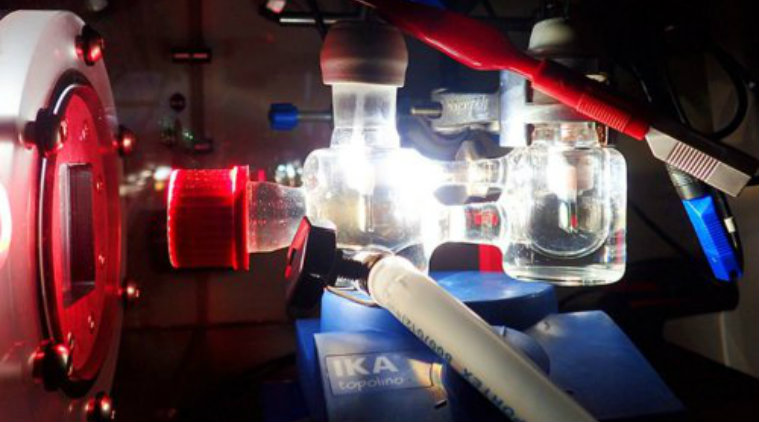 The team not only improved on the amount of energy produced and stored,
they managed to reactivate a process in the algae that has been dormant
for millennia. (Image: St John’s College)
The team not only improved on the amount of energy produced and stored,
they managed to reactivate a process in the algae that has been dormant
for millennia. (Image: St John’s College)