5 days ago — Mitochondria appear to communicate and cooperate with one another, bothwithin and between cells. Biologists are only just beginning to understand how and why. ... cell biology. 'Social' Mitochondria, Whispering Between Cells, Influence Health ...
8 days ago — What will that mean for how we treat objects and the world around us? Buckle in, because things are about to get weird. What Is Consciousness?
16-Jun-2017 — Some of the world's most renowned scientists are questioning ... Put more bluntly, the entire cosmos may be self-aware. The notion of a conscious universe sounds more like the stuff of late night ... an unbalanced process that could cause a star to alter its motion. ... But here's what's changed, scientists say.
25-Apr-2021 — Leading scientists have long pondered how matter gives rise to our subjective experience of reality and believe consciousness could even ... As humans, we know we are conscious because we experience and feel things. ... Some prominent minds lend weight to the view of panpsychism, not least ...
Earlier this spring, a paper studying covid forecasting appeared on the medRxiv preprint server with an authors’ list running 256 names long.
At
the end of the list was Nicholas Reich, a biostatistician and
infectious-disease researcher at the University of Massachusetts,
Amherst. The paper reported results of a massive modeling project that
Reich has co-led, with his colleague Evan Ray, since the early days of
the pandemic. The project began with their attempts to compare various
models online making short-term forecasts about covid-19 trajectories,
looking one to four weeks ahead, for infection rates, hospitalizations,
and deaths. All used varying data sources and methods and produced
vastly divergent forecasts.
“I spent a few nights with forecasts
on browsers on multiple screens, trying to make a simple comparison,”
says Reich (who is also a puzzler and a juggler). “It was impossible.”
In
an effort to standardize an analysis, in April 2020, Reich’s lab, in
collaboration with US Centers for Disease Control and Prevention,
launched the “COVID-19 Forecast Hub.” The hub aggregates
and evaluates weekly results from many models and then generates an
“ensemble model.” The upshot of the study, Reich says, is that “relying
on individual models is not the best approach. Combining or synthesizing multiple models will give you the most accurate short-term predictions.”
“The sharper you define the target, the less likely you are to hit it.”
Sebastian Funk
The
purpose of short-term forecasting is to consider how likely different
trajectories are in the immediate future. This information is crucial
for public health agencies in making decisions and implementing policy,
but it’s hard to come by, especially during a pandemic amid
ever-evolving uncertainty.
Sebastian Funk, an infectious disease
epidemiologist at the London School of Hygiene & Tropical Medicine,
borrows from the great Swedish physician Hans Rosling, who in reflecting on his experience
helping the Liberian government fight the 2014 Ebola epidemic,
observed: “We were losing ourselves in details ... All we needed to know
is, are the number of cases rising, falling, or leveling off?”
“That
in itself is not always a trivial task, given that noise in different
data streams can obscure true trends,” says Funk, whose team contributes
to the US hub, and this past March launched a parallel venture, the European COVID-19 Forecast Hub, in collaboration the European Centre for Disease Prevention and Control.
Trying to hit the bull’s eye
To
date, the US COVID-19 Forecast Hub has included submissions from about
100 international teams, in academia, industry, and government, as well
as independent researchers, such as the data scientist Youyang Gu.
Most teams try to mirror what’s happening in the world with a standard
epidemiological framework. Others use statistical models that crunch
numbers looking for trends, or deep learning techniques; some
mix-and-match.
Every
week, teams each submit not only a point forecast predicting a single
number outcome (say, that in one week there will be 500 deaths). They
also submit probabilistic predictions that quantify the uncertainty by
estimating the likelihood of the number of cases or deaths at intervals,
or ranges, that get narrower and narrower, targeting a central
forecast. For instance, a model might predict that there’s a 90 percent
probability of seeing 100 to 500 deaths, a 50 percent probability of
seeing 300 to 400, and 10 percent probability of seeing 350 to 360.
“It’s like a bull’s eye, getting more and more focused,” says Reich.
Funk
adds: “The sharper you define the target, the less likely you are to
hit it.” It’s fine balance, since an arbitrarily wide forecast will be
correct, and also useless. “It should be as precise as possible,” says
Funk, “while also giving the correct answer.”
In collating and
evaluating all the individual models, the ensemble tries to optimize
their information and mitigate their shortcomings. The result is a
probabilistic prediction, statistical average, or a “median forecast.”
It’s a consensus, essentially, with a more finely calibrated, and hence
more realistic, expression of the uncertainty. All the various elements
of uncertainty average out in the wash.
The study by Reich’s
lab, which focused on projected deaths and evaluated about 200,000
forecasts from mid-May to late-December 2020 (an updated analysis with
predictions for four more months will soon be added), found that the
performance of individual models was highly variable. One week a model
might be accurate, the next week it might be way off. But, as the
authors wrote, “In combining the forecasts from all teams, the ensemble
showed the best overall probabilistic accuracy.”
And these
ensemble exercises serve not only to improve predictions, but also
people’s trust in the models, says Ashleigh Tuite, an epidemiologist at
the Dalla Lana School of Public Health at the University of Toronto.
“One of the lessons of ensemble modeling is that none of the models is
perfect,” Tuite says. “And even the ensemble sometimes will miss
something important. Models in general have a hard time forecasting
inflection points—peaks, or if things suddenly start accelerating or
decelerating.”
“Models are not oracles.”
Alessandro Vespignani
The
use of ensemble modeling is not unique to the pandemic. In fact, we
consume probabilistic ensemble forecasts every day when Googling the
weather and taking note that there’s 90 percent chance of precipitation.
It’s the gold standard for both weather and climate predictions.
“It’s
been a real success story and the way to go for about three decades,”
says Tilmann Gneiting, a computational statistician at the Heidelberg
Institute for Theoretical Studies and the Karlsruhe Institute of
Technology in Germany. Prior to ensembles, weather forecasting used a
single numerical model, which produced, in raw form, a deterministic
weather forecast that was “ridiculously overconfident and wildly
unreliable,” says Gneiting (weather forecasters, aware of this problem,
subjected the raw results to subsequent statistical analysis that produced reasonably reliable probability of precipitation forecasts by the 1960s).
Gneiting
notes, however, that the analogy between infectious disease and weather
forecasting has its limitations. For one thing, the probability of
precipitation doesn’t change in response to human behavior—it’ll rain,
umbrella or no umbrella—whereas the trajectory of the pandemic responds
to our preventative measures.
Forecasting during a pandemic is a
system subject to a feedback loop. “Models are not oracles,” says
Alessandro Vespignani, a computational epidemiologist at Northeastern
University and ensemble hub contributor, who studies complex networks
and infectious disease spread with a focus on the “techno-social”
systems that drive feedback mechanisms. “Any model is providing an
answer that is conditional on certain assumptions.”
When people
process a model’s prediction, their subsequent behavioral changes upend
the assumptions, change the disease dynamics and render the forecast
inaccurate. In this way, modeling can be a “self-destroying prophecy.”
And
there are other factors that could compound the uncertainty:
seasonality, variants, vaccine availability or uptake; and policy
changes like the swift decision from the CDC about unmasking. “These all
amount to huge unknowns that, if you actually wanted to capture the
uncertainty of the future, would really limit what you could say,” says
Justin Lessler, an epidemiologist at the Johns Hopkins Bloomberg School
of Public Health, and a contributor to the COVID-19 Forecast Hub.
The
ensemble study of death forecasts observed that accuracy decays, and
uncertainty grows, as models make predictions farther into the
future—there was about two times the error looking four weeks ahead
versus one week (four weeks is considered the limit for meaningful
short-term forecasts; at the 20-week time horizon there was about five
times the error).
“It’s fair to debate when things worked and when things didn’t.”
Johannes Bracher
But
assessing the quality of the models—warts and all—is an important
secondary goal of forecasting hubs. And it’s easy enough to do, since
short-term predictions are quickly confronted with the reality of the
numbers tallied day-to-day, as a measure of their success.
Most
researchers are careful to differentiate between this type of “forecast
model,” aiming to make explicit and verifiable predictions about the
future, which is only possible in the short- term; versus a “scenario
model,” exploring “what if” hypotheticals, possible plotlines that might
develop in the medium- or long-term future (since scenario models are
not meant to be predictions, they shouldn’t be evaluated retrospectively
against reality).
During the pandemic, a critical spotlight has
often been directed at models with predictions that were spectacularly
wrong. “While longer-term what-if projections are difficult to evaluate,
we shouldn’t shy away from comparing short-term predictions with
reality,” says Johannes Bracher, a biostatistician at the Heidelberg
Institute for Theoretical Studies and the Karlsruhe Institute of
Technology, who coordinates a German and Polish hub,
and advises the European hub. “It’s fair to debate when things worked
and when things didn’t,” he says. But an informed debate requires
recognizing and considering the limits and intentions of models
(sometimes the fiercest critics were those who mistook scenario models
for forecast models).
“The big question is, can we improve?”
Nicholas Reich
Similarly,
when predictions in any given situation prove particularly intractable,
modelers should say so. “If we have learned one thing, it’s that cases
are extremely difficult to model even in the short run,” says Bracher.
“Deaths are a more lagged indicator and are easier to predict.”
In
April, some of the European models were overly pessimistic and missed a
sudden decrease in cases. A public debate ensued about the accuracy and
reliability of pandemic models. Weighing in on Twitter, Bracher asked:
“Is it surprising that the models are (not infrequently) wrong? After a
1-year pandemic, I would say: no.” This makes it all the more
important, he says, that models indicate their level of certainty or
uncertainty, that they take a realistic stance about how unpredictable
cases are, and about the future course. “Modelers need to communicate
the uncertainty, but it shouldn’t be seen as a failure,” Bracher says.
Trusting some models more than others
As
an oft-quoted statistical aphorism goes, “All models are wrong, but
some are useful.” But as Bracher notes, “If you do the ensemble model
approach, in a sense you are saying that all models are useful, that
each model has something to contribute”—though some models may be more
informative or reliable than others.
Observing this fluctuation
prompted Reich and others to try “training” the ensemble model—that is,
as Reich explains, “building algorithms that teach the ensemble to
‘trust’ some models more than others and learn which precise combination
of models works in harmony together.” Bracher’s team now contributes a
mini-ensemble, built from only the models that have performed
consistently well in the past, amplifying the clearest signal.
“The
big question is, can we improve?” Reich says. “The original method is
so simple. It seems like there has to be a way of improving on just
taking a simple average of all these models.” So far, however, it is
proving harder than expected—small improvements seem feasible, but
dramatic improvements may be close to impossible.
A
complementary tool for improving our overall perspective on the pandemic
beyond week-to-week glimpses is to look further out on the time
horizon, four to six months, with those “scenario modeling.” Last
December, motivated by the surge in cases and the imminent availability
of the vaccine, Lessler and collaborators launched the COVID-19 Scenario Modeling Hub, in consultation with the CDC.
Scenario
models put bounds on the future based on well-defined “what if”
assumptions—zeroing in on what are deemed to be important sources of
uncertainty and using them as leverage points in charting the course
ahead.
To this end, Katriona Shea, a theoretical ecologist at
Penn State University and a scenario hub coordinator, brings to the
process a formal approach to making good decisions in an uncertain
environment—drawing out the researchers via “expert elicitation,”
aiming for a diversity of opinions, with a minimum of bias and
confusion. In deciding what scenarios to model, the modelers discuss
what might be important upcoming possibilities, and they ask policy makers for guidance about what would be helpful.
They
also consider the broader chain of decision-making that follows
projections: decisions by business owners around reopening, and
decisions by the general public around summer vacation; decisions
triggering levers that can be pulled in hopes of changing the pandemic’s
course, others simply informing what viable strategies can be adopted
to cope.
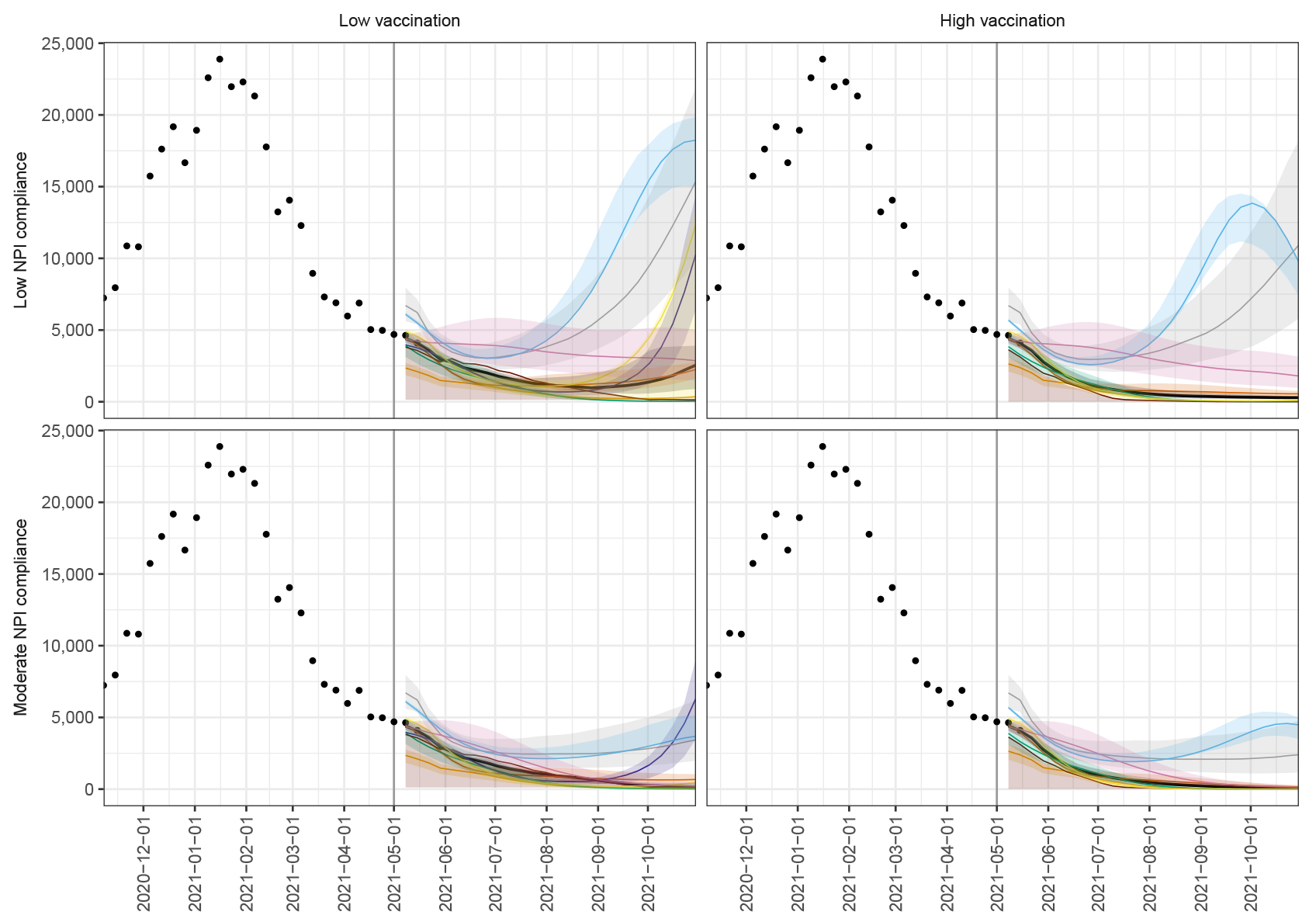
The hub just finished its fifth round
of modeling with the following scenarios: What are the case,
hospitalization and death rates from now through October if the vaccine
uptake in the US saturates nationally at 83 percent? And what if vaccine
uptake is 68 percent? And what are the trajectories if there is a
moderate 50 percent reduction in non-pharmaceutical interventions such
as masking and social distancing, compared with an 80 percent reduction?
The
Scenario Modeling Hub's round five projections of deaths (y-axis) over
time (x-axis), considering low-versus-high vaccination rates, and
low-versus-moderate interventions (masking, social distancing). The
colors represent projections by different modelling teams; the color
bands indicate the range of uncertainty. The black line represents the
ensemble model's projections.
SCENARIO MODELING HUB
With
some of the scenarios, the future looks good. With the higher
vaccination rate and/or sustained non-pharmaceutical interventions such
as masking and social distancing, “things go down and stay down,” says
Lessler. With the opposite extreme, the ensemble projects a resurgence
in the fall—though the individual models show more qualitative
differences for this scenario, with some projecting that cases and
deaths stay low, while others predict far larger resurgences than the
ensemble.
The hub will model a few more rounds yet, though
they’re still discussing what scenarios to scrutinize—possibilities
include more highly transmissible variants, variants achieving immune
escape, and the prospect of waning immunity several months after
vaccinations.
We can’t control those scenarios in terms of
influencing their course, Lessler says, but we can contemplate how we
might plan accordingly.
Of course, there’s only one scenario
that any of us really want to mentally model. As Lessler puts it, “I’m
ready for the pandemic to be over.”Article meta