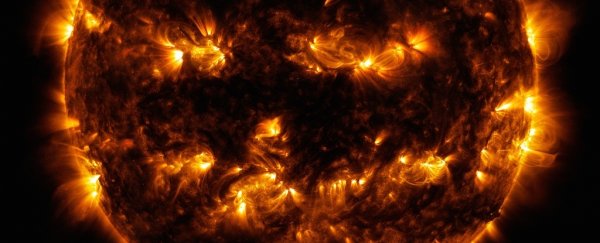
Scientists Figured Out How And When Our Sun Will Die, And It's Going to Be Epic
What will our Sun look like after it dies? Scientists have made
predictions about what the end will look like for our Solar System, and
when that will happen. And humans won't be around to see the final act.
Previously, astronomers thought it would turn into a planetary nebula
– a luminous bubble of gas and dust – until evidence suggested it would
have to be a fair bit more massive.
An international team of
astronomers flipped it again in 2018 and found that a planetary nebula
is indeed the most likely solar corpse.
The Sun is about 4.6
billion years old – gauged on the age of other objects in the Solar
System that formed around the same time. Based on observations of other
stars, astronomers predict it will reach the end of its life in about
another 10 billion years.
There are other things that will happen
along the way, of course. In about 5 billion years, the Sun is due to
turn into a red giant. The core of the star will shrink, but its outer
layers will expand out to the orbit of Mars, engulfing our planet in the process. If it's even still there.
One
thing is certain: By that time, we won't be around. In fact, humanity
only has about 1 billion years left unless we find a way off this rock.
That's because the Sun is increasing in brightness by about 10 percent every billion years.
That doesn't sound like much, but that increase in brightness
will end life on Earth. Our oceans will evaporate, and the surface will
become too hot for water to form. We'll be about as kaput as you can
get.
It's what comes after the red giant that has proven difficult to pin down. Several previous studies have found that, in order for a bright planetary nebula to form, the initial star needs to have been up to twice as massive as the Sun.
However,
the 2018 study used computer modeling to determine that, like 90
percent of other stars, our Sun is most likely to shrink down from a red
giant to become a white dwarf and then end as a planetary nebula.
"When
a star dies it ejects a mass of gas and dust – known as its envelope –
into space. The envelope can be as much as half the star's mass. This
reveals the star's core, which by this point in the star's life is
running out of fuel, eventually turning off and before finally dying," explained astrophysicist Albert Zijlstra from the University of Manchester in the UK, one of the authors of the paper.
"It is only then the hot core makes the ejected envelope shine
brightly for around 10,000 years – a brief period in astronomy. This is
what makes the planetary nebula visible. Some are so bright that they
can be seen from extremely large distances measuring tens of millions of
light years, where the star itself would have been much too faint to
see."
The data model that the team created actually predicts the
life cycle of different kinds of stars, to figure out the brightness of
the planetary nebula associated with different star masses.
Planetary
nebulae are relatively common throughout the observable Universe, with
famous ones including the Helix Nebula, the Cat's Eye Nebula, the Ring
Nebula, and the Bubble Nebula.
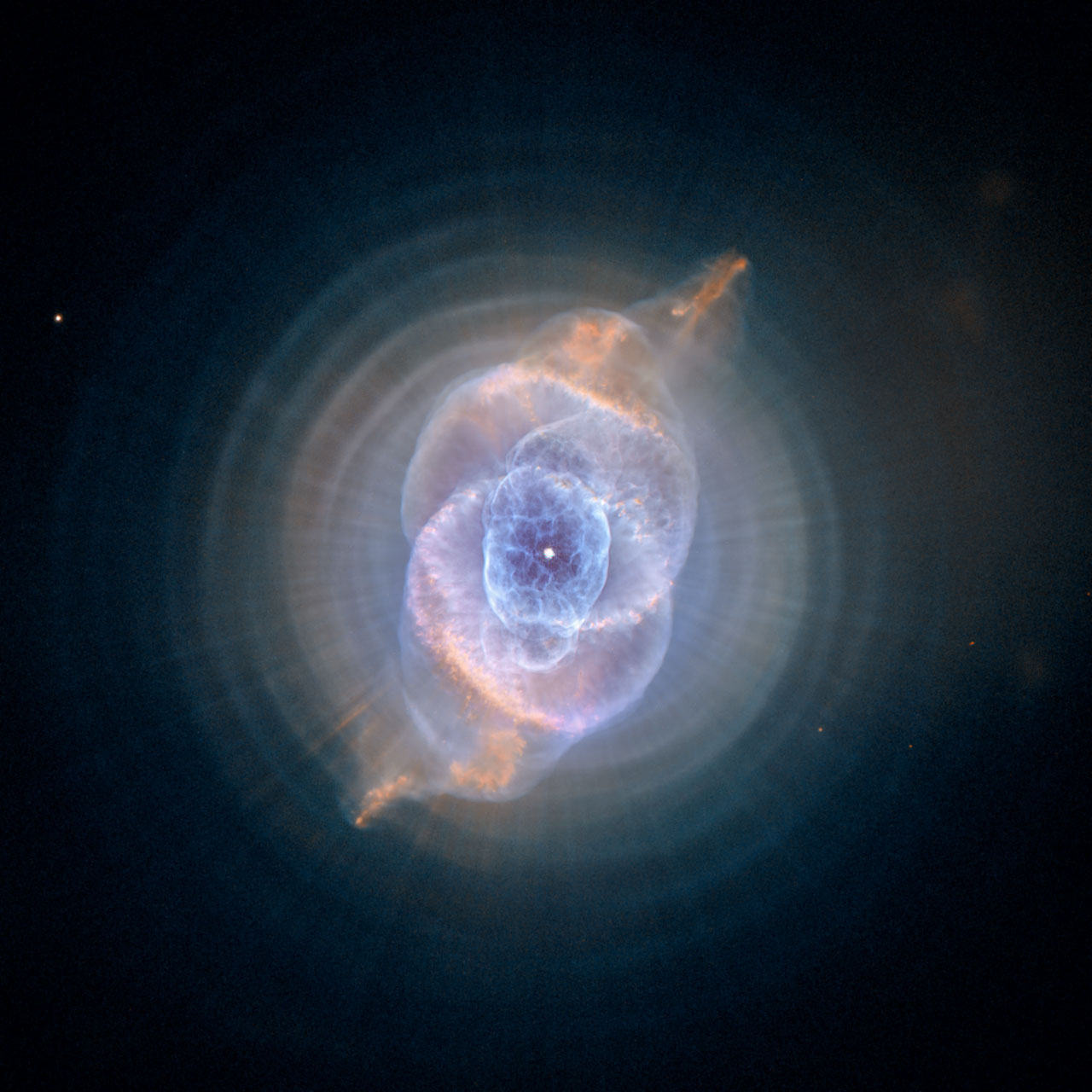 Cat's Eye Nebula (NASA/ESA)
They're
named planetary nebulae not because they actually have anything to do
with planets, but because, when the first ones were discovered by
William Herschel in the late 18th century, they were similar in appearance to planets through the telescopes of the time.
Almost
30 years ago, astronomers noticed something peculiar: The brightest
planetary nebulae in other galaxies all have about the same level of
brightness. This means that, theoretically at least, by looking at the
planetary nebulae in other galaxies, astronomers can calculate how far
away they are.
The data showed that this was correct, but the models
contradicted it, which has been vexing scientists ever since the
discovery was made.
"Old, low mass stars should make much fainter
planetary nebulae than young, more massive stars. This has become a
source of conflict for the past 25 years," said Zijlstra
"The
data said you could get bright planetary nebulae from low mass stars
like the Sun, the models said that was not possible, anything less than
about twice the mass of the Sun would give a planetary nebula too faint
to see."
The 2018 models have solved this problem by showing that
the Sun is about the lower limit of mass for a star that can produce a
visible nebula.
Even a star with a mass less than 1.1 times that
of the Sun won't produce a visible nebula. Bigger stars up to 3 times
more massive than the Sun, on the other hand, will produce the brighter
nebulae.
For all the other stars in between, the predicted brightness is very close to what has been observed.
"This is a nice result," Zijlstra said.
"Not only do we now have a way to measure the presence of stars of ages
a few billion years in distant galaxies, which is a range that is
remarkably difficult to measure, we even have found out what the Sun
will do when it dies!"
The research has been published in the journal Nature Astronomy.
An earlier version of this article was first published in May 2018.
RELATED NEWS :-
Scale of the Universe - Be Amazed!
Everyone
knows the universe is huge, but most people don't understand how huge
it really is. This article will try to show the amazingly massive scale
of the universe to you. It surely is a very humbling experience!

EARTH - OUR HOME
This is our Home. All of us live, love, wage wars, spend our entire lifetimes here.
EARTH COMPARED TO SMALLER PLANETS IN OUR SOLAR SYSTEM
EARTH COMPARED TO LARGER PLANETS IN OUR SOLAR SYSTEM
COMPARED TO OUR SUN
OUR SUN COMPARED TO OTHER STARS
Our Sun is just a tiny speck compared to other stars!
Hard to even make out in the picture with the Sun just 1 pixel wide. Jupiter becomes invisible at this scale.
MILKY WAY - OUR GALAXY
There are 200-400 billion stars in the Milky Way.
The
stellar disk of the Milky Way Galaxy is approximately 100,000
light-years in diameter, and is considered to be, on average, about
1,000 ly thick.
Our Milky Way galaxy is small compared to other galaxies. Our neighbouring Andromeda Galaxy has over one trillion stars!
THE OBSERVABLE UNIVERSE
This is a Hubble Ultra Deep Field image of a small region of the observable universe (equivalent sky area size shown in bottom left corner).
Each spot is a galaxy, consisting of billions of stars.
There are more than 170 billion galaxies in the observable universe.
Be Amazed!
Read more: http://www.funonthenet.in/articles/scale-of-the-universe.html#ixzz1oJQ0IbU8=====================================================================
Sun will swallow Earth: Official
No escape from star's clutches
By Lester Haines • Get more from this author
Posted in Space, 27th February 2008 10:09 GMT
WIN - A free one year, 25 user licence of Microsoft Office 365!
Two
scientists from the University of Sussex and Mexico's University of
Guanajuato appear to have confirmed that if we're still around in 7.6
billion years, global warming will be the least of our worries, since
our beloved Mother Earth will be drawn inexorably towards the Sun and
snuffed from existence.
Sussex Uni's Robert Smith and Guanajuato's
Klaus-Peter Schroeder got out their calculators to determine once and
for all whether Earth would escape a blazing death by spinning into a
more distant orbit around the Sun, or whether it's ultimately curtains.
The
former theory suggests that, as the Sun expands into a red giant, it
will eject its outer gaseous layers, thereby losing mass and weakening
its gravitational grip on the Blue Marble.
However, this
get-out clause doesn't factor in tidal forces or the drag of the Sun's
outer layer, according to the doomsday boffins. The Earth actually
exerts its own (modest) gravitational pull on the Sun, causing the face
closest to us to bulge out - an extrusion which constitutes bad
long-term news.
Smith explained to Space.com: "Just as the Earth
is pulling on the Sun's bulge, it's pulling on the Earth, and that
causes the Earth to slow in its orbit. It will spiral back and finally
end up inside the Sun."
In addition to this fatal attraction, the
gaseous layers escaping from the Sun will exacerbate the problem,
creating drag on Earth's orbit, further slowing it.
Smith said
these crucial factors had hitherto been overlooked in determining
Earth's fate. He explained: "Although people have looked at these
problems before, we would claim this is the best attempt that's been
made to date, and probably the most reliable. What we've done is to
refine existing models and to put the best calculations we can at each
point in the model."
Of course, while it's interesting to ponder
our planet's distant fate, we'll actually be long gone before the
fireworks. Smith predicted: "After a billion years or so you've got an
Earth with no atmosphere, no water and a surface temperature of hundreds
of degrees, way above the boiling point of water. The Earth will become
dry basically. It will become completely impossible for life of any
kind to exist. It's a pretty gloomy forecast."
The researchers' findings will be published in the journal Monthly Notices of the Royal Astronomical Society. ®
On the other hand...
Last September we reported
on a "red giant survivor" V 391 Pegasi b, which was spied orbiting its
bloated mother star "slightly beyond" the expansion zone within which
planets are doomed.
Roberto Silvotti, researcher at the
INAF-Osservatorio Astronomico di Capodimonte, said: "As far as our
planets are concerned, we expect Mercury and Venus to disappear in the
Sun's envelope, whereas Mars should survive.
"The fate of the
Earth is less clear because its position is really at the limit. All
this will happen in about five billion years, when the Earth will be
more or less the same age as V 391 Pegasi b, i.e. 10 billion years."
======================================================================================
When galaxies collide: How the sky will look when Milky Way crashes into Andromeda system... in four billion years
- Collision between galaxies will happen in four billion years
- Stars will be tossed into different orbit around Milky Way's core - including our Sun
- Two billion years later, the two galaxies will 'merge' into one
By CHRISTINE SHOW
PUBLISHED: 03:16 GMT, 1 June 2012 | UPDATED: 17:53 GMT, 2 June 2012
This
incredible image shows how our skies will look when the Milky Way
galaxy collides with our cosmic neighbour, the Andromeda galaxy, in four
billion years.
Astronomers at NASA have confirmed that, according to their latest models, a major collision will occur in a major cosmic event.
The
head-on encounter is expected to happen four billion years from now -
catapulting our sun to another area of the galaxy, with stars tossed on
to different orbits, astronomers at the Space Telescope Science
Institute revealed on Thursday.

Starting off as a tiny speck in the distance, the galaxy known as Andromeda (left of the picture) looks harmless at first

Previously just a small dot, earthlings of the future would be forgiven for panicking as Andromeda moves closer to our galaxy

The formerly tiny galaxy now dominates the foreground of the computer generated image as it swallows up the Milky Way

The
Aftermath: Following the collision of the two galaxies, a countless
number of stars will be sent spinning into space as Andromeda and the
Milky Way lose their previous forms
Although Earth and its solar system won't be destroyed, it will be pushed away from the galactic core more than it is now.
'After
nearly a century of speculation about the future destiny of Andromeda
and our Milky Way, we at last have a clear picture of how events will
unfold over the coming billions of years,' said Sangmo Tony Sohn,
Baltimore, Maryland-based institute.
After
the Andromeda galaxy finally strikes the Milky Way, it will be another
two billion years before the two totally come together and form a single
elliptical galaxy.

Colossal:
This NASA illustration shows the Milky Way (left) and the Andromeda
galaxy, which are expected to collide in four billion years from now

Impact:
Earth won't be destroyed when Andromeda smashes into the Milky Way
(pictured), but stars will likely be tossed into different orbits and it
will take an additional two billion years for the two galaxies to
totally merge
A
mutual pull of gravity is bringing the two galaxies together as
Andromeda, known to scientists as M31, falls at a ferocious rate toward
the Milky Way.
Andromeda is currently 2.5million light-years away.
'In
the 'worst-case scenario' simulation, M31 slams into the Milky Way
head-on and the stars are all scattered into orbits,' said team member
Gurtina Besla in a statement.
The Andromeda is plowing toward Earth's galaxy at roughly 250,000 miles per hour.
That rate is the equivalent of traveling from Earth to the moon in an hour.
Astronomers
also believe a third, smaller galaxy called the Triangulum will also be
a part of the collision and could join the Milky Way and Andromeda
mash-up.

Fast:
Andromeda (pictured) is plowing toward Earth's galaxy at roughly
250,000 miles per hour, which is the equivalent of traveling from Earth
to the moon in 60 minutes
It previously had been difficult to determine whether the two galaxies would slam into each other.
Members
of the NASA Hubble Space Telescope team, however, were able to make
certain that the two will crash with exact views of Andromeda's sideways
motion.

Change: When the two galaxies collide, the sun (pictured) will be catapulted across another area of the galaxy
'This
was accomplished by repeatedly observing select regions of the galaxy
over a five- to seven-year period,' said the institute's Jay Anderson,
in a statement.
The
astronomers used extremely powerful cameras to capture the measurements
that were crucial to understand the motion of Andromeda.
As
the universe expands and accelerates, collisions can happen between two
galaxies close together because of the gravity from dark matter around
them.
These types of mergers were more likely to happen in the past when the universe was not as large as it is today.

 It was first imagined by the pioneering Russian scientist Konstantin Tsiolkovsky in the 1920s, decades before space launches or satellites
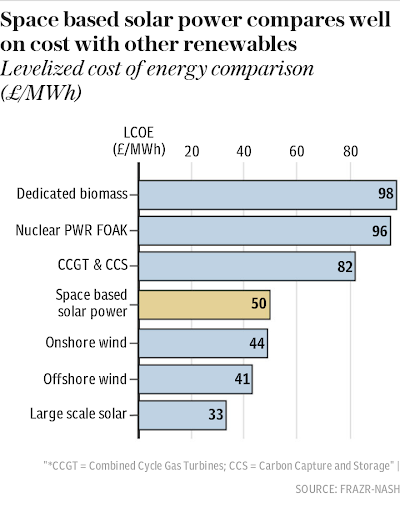
 Frazer-Nash has predicted that five systems would cost around £16.3bn to research and then launch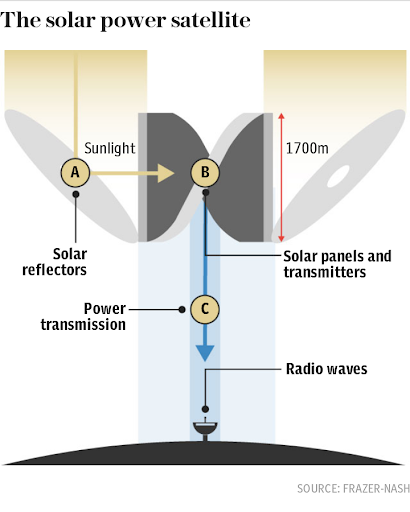
 But if the Government needs grand ideas to get the UK towards net-zero, it couldn’t ask for one much bigger than this.
 Read Technology Editor 's full report here