Implants, nerve and muscles transferring · by M Bumbaširević · 2020 · Cited by 18 — Bionic limbs can be divided into three main groups, ... by Kuiken involves the transfer (rerouting) of the ...
The current state of bionic limbs from the surgeon’s viewpoint
These approaches have the scope to replicate the near-to-natural motor
and sensory limb functionalities of an intact limb, replacing it with an
active and sensorized prosthetic device.As a result of these
innovations, ‘bionic limbs’ were developed and represent the newest
achievement in prosthetics. =============================================
META VERSE:- USING BELOW TECHNOLOGY FOR WHAT KURZWEIL PREDICTED AS FUTURISTIC " SEX BETWEN 2 INDIVIDUALS CONNECTED BY INTERNET :- THE PROSTHETIC DEVICE SHOULD BE ON X PERSON/WOMAN AND CONNECTED BY WIRES/INTERNET IT REACHES Y PERSON/MAN -AND HE GETSnear-to-natural motor
and sensory PLEASURES
near-to-natural motor
and sensory limb functionalities of an intact limb, replacing it with an
active and sensorized prosthetic device.
Developments in artificial intelligence (AI) are leading to fundamental changes in the way we live. Algorithms can already detect ...
CC
How a 195-year-old discovery could build the future of energy
The need to transition to clean energy is apparent, urgent, and inescapable.
PhotoQuest/Archive Photos/Getty Images
Jan-Hendrik Pöhls
The need to transition to clean energy is apparent, urgent, and inescapable. We must limit Earth’s rising temperature
to within 1.5 C to avoid the worst effects of climate change — an
especially daunting challenge in the face of the steadily increasing global demand for energy.
Part of the answer is using energy more efficiently. More than 72 percent of all energy produced worldwide is lost in the form of heat. For example, the engine in a car uses only about 30 percent of the gasoline it burns to move the car. The remainder is dissipated as heat.
Recovering even a tiny fraction of that lost energy would have a tremendous impact on climate change. Thermoelectric materials, which convert wasted heat into useful electricity, can help.
Until
recently, the identification of these materials had been slow. My
colleagues and I have used quantum computations — a computer-based
modeling approach to predict materials’ properties — to speed up that
process and identify more than 500 thermoelectric materials that could
convert excess heat to electricity, and help improve energy efficiency.
Thomas Johann SeebeckBettmann/Bettmann/Getty Images
The
transformation of heat into electrical energy by thermoelectric
materials is based on the “Seebeck effect.” In 1826, German physicist
Thomas Johann Seebeck observed
that exposing the ends of joined pieces of dissimilar metals to
different temperatures generated a magnetic field, which was later
recognized to be caused by an electric current.
In 1929, the Russian scientist Abraham Ioffe
revolutionized the field of thermoelectricity. He observed that
semiconductors — materials whose ability to conduct electricity falls
between that of metals (like copper) and insulators (like glass) —
exhibit a significantly higher Seebeck effect than metals, boosting
thermoelectric efficiency 40-fold, from 0.1 percent to four percent.
This discovery led to the development of the first widely used thermoelectric generator, the Russian lamp — a kerosene lamp that heated a thermoelectric material to power a radio.
In the 2015 film, The Martian, astronaut Mark Watney (Matt Damon) digs up a buried thermoelectric generator to use the power source as a heater.
Despite
this vast diversity of applications, the wide-scale commercialization
of thermoelectric materials is still limited by their low efficiency.
What’s
holding them back? Two key factors must be considered: the conductive
properties of the materials, and their ability to maintain a temperature
difference, which makes it possible to generate electricity.
The
best thermoelectric material would have the electronic properties of
semiconductors and the poor heat conduction of glass. But this unique
combination of properties is not found in naturally occurring materials.
We have to engineer them.
Searching for a needle in a haystack — In
the past decade, new strategies to engineer thermoelectric materials
have emerged due to an enhanced understanding of their underlying
physics. In a recent study in Nature Materials,
researchers from Seoul National University, Aachen University, and
Northwestern University reported they had engineered a material called
tin selenide with the highest thermoelectric performance to date, nearly
twice that of 20 years ago. But it took them nearly a decade to
optimize it.
To speed up the discovery process, my colleagues and I
have used quantum calculations to search for new thermoelectric
candidates with high efficiencies. We searched a database containing
thousands of materials to look for those that would have high electronic
qualities and low levels of heat conduction, based on their chemical
and physical properties. These insights helped us find the best
materials to synthesize and test and calculate their thermoelectric
efficiency.
We are almost at the point where thermoelectric
materials can be widely applied, but first, we need to develop much more
efficient materials. With so many possibilities and variables, finding
the way forward is like searching for a tiny needle in an enormous
haystack.
Just
as a metal detector can zero in on a needle in a haystack, quantum
computations can accelerate the discovery of efficient thermoelectric
materials. Such calculations can accurately predict electron and heat
conduction (including the Seebeck effect) for thousands of materials and
unveil the previously hidden and highly complex interactions between those properties, which can influence a material’s efficiency.
Large-scale
applications will require thermoelectric materials that are
inexpensive, non-toxic, and abundant. Lead and tellurium are found in
today’s thermoelectric materials, but their cost and negative
environmental impact make them good targets for replacement.
Quantum
calculations can be applied in a way to search for specific sets of
materials using parameters such as scarcity, cost, and efficiency.
Although those calculations can reveal optimum thermoelectric materials,
synthesizing the materials with the desired properties remains a
challenge.
A multi-institutional effort involving government-run
laboratories and universities in the United States, Canada, and Europe
have revealed more than 500 previously unexplored materials
with high predicted thermoelectric efficiency. My colleagues and I are
currently investigating the thermoelectric performance of those
materials in experiments, and have already discovered new sources of
high thermoelectric efficiency.
Those
initial results strongly suggest that further quantum computations can
pinpoint the most efficient combinations of materials to make clean
energy from wasted heat and avert the catastrophe that looms over our
planet.
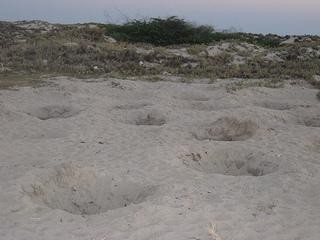
Pits made in the sand that provide sweet drinking water to the fishing community
Sweet drinking water found on the sandy beach flanked on both sides by the two oceans
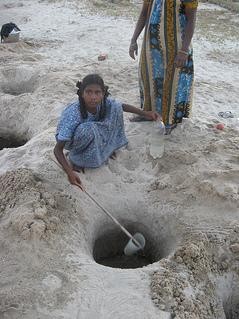
The women
collect this water, filtering it through a piece of cloth in their
pots. They offer us some water. We are surprised to find that the water
is very sweet and free of any salt!
Women from the fishing communities collecting drinking water from the pits made in the sand
We
reach the end of the land where the two oceans meet and take in the
view of the deep blue sea, gradually changing colours with the setting
of the sun and the rising of the moon, wondering how such peace and
tranquility can at times, also unleash such fury and destruction, but
then, time goes on and heals all wounds!
References
1.
Dhanushkodi: The Wikipedia, the Free Encyclopedia. Downloaded from the
link http://en.wikipedia.org/wiki/Dhanushkodi on the 14th of March 2013
Today, one out of three people don't have access to safe drinking water. And that's the result of many things, but one of them is ... ...............................................................................................
MY THOUGHTS/INSPIRATIONS /EXPIRATIONS
how there is non salty water available from wells just 10 feet =3 meter from sea in verssova beach?
09-Sept-2012 — In Rameswaram, an Island on the South east coast of India, there is a well some distance into the sea that provides water which is not salty ...
In Rameswaram, an Island on the South east coast of India,
there is a well some distance into the sea that provides water which is
not salty and can be drunk. This is a holy place and according to Hindu
mythology Lord Rama shot an arrow into the sea to get water to drink
for his wife Sita. This is known as the Villundi Tīrtham well. How is
it possible that you get non-salty water amid the sea water?
The Earth has Oceans which occur in “basins”. Continents, that is
land we live on, is higher than the water level in the Oceans. (If you
are keen for more, read about Isostasy.)
On land, groundwater occurs beneath the surface in what geologists
call as Aquifers. Aquifers are geologic formations that can store and
transmit water. Note that geologic formations are rock strata that have
similar properties (for example rocks of a certain chemical and mineral
nature is one such property). These have been deposited over millions of
years (if you are interested read about stratigraphy, erosion,
landforms, geologic time, etc).
Aquifer (from wikipedia)
Salt water-Freshwater interface
Well water
Water on the beach
A well in the sea – at Rameswaram
Under some instances water gets collected from rain, rivers, and other sources and is stored underground in aquifers.
Aquifers constantly interact with other water sources, atmosphere,
and is governed by forces such as pressure and gravity. The geologic
formations too determine the aquifer’s nature – porosity, permeability,
storage capacity, etc.
Groundwater near the coast interacts with the sea water too. The
figure (source: Solinst) shows theoretically how groundwater exists. In
reality though it is very complex.
Groundwater is recharged by rain and lakes or rivers. Thus
Groundwater is not stagnant and flows. The flow is described by Darcy’s
law which in simple terms means “groundwater flows depending on pressure
and the length of the aquifer medium”. This pressure is the reason we
are able to dig wells. This is often the capillary pressure.
Groundwater can be confined within strata and be under pressure. Or
it may not have a confining layer and could be seen close to the
surface.
The level to which groundwater can raise is the water table. Of
course this is only for groundwater that is not confined by impervious
or semi impervious strata. The potentiomentric surface is used to
describe the water table level.
On the coasts, groundwater exists in “dynamic and often transient
equilibrium” with sea water. Sea water is denser and filtrates into the
ground beneath the sea and on to the land.
Groundwater should flow – discharge into the sea – as long as the
water table level is at a higher pressure gradient. Sea water in turn
will try to flow in and contaminate the fresh groundwater. There is a
seawater-freshwater interface (not a sharp line!) that is transient and
keeps changing with rainfall, river or lake discharge, tides and
evaporation.
If humans pump out water from the coastal areas, sea water intrudes
the fresher groundwater. The Gyben-Herzberg equation governs the fresher
groundwater aquifer-sea water interface. For every feet of water on the
surface, some 40 feet of groundwater exists below sea level.
So what does it have to do with this freshwater well in the sea? If
you dig a well in the sea you expect to get saline water. Yet, the well
provides drinkable water because of these possible scenarios:- the
freshwater-sea water interface extends far into the sea even beneath the
waves. Highly unlikely as the water table pressure would need to be
immensely high on the land!
– there is submarine discharge of groundwater from a confined aquifer
beneath the sea at this place. The strata confining the aquifer prevents
water from seeping out on the land side but there is a hidden interface
on the sea side.This is possible.
– maybe seawater has “transgressed” only on the surface and below the
surface is stopped from infiltering by impervious formations.
So this must be some kind of mix of these situations. The sea water
here is pretty static – no waves in sight. Modeling coastal aquifers is a
major headache. On Islands, the Fetter analytical solution applies
better. I will not describe that here.
Usually, salt water intrusion into coastal aquifers is due to:
– lateral movement of salt water from the sea due to heavy water loss (withdrawals by humans) from the coastal aquifers
– “Saline zones” deep in the interface move up to cause “upconing” near coastal pumping wells
So is it possible? Yes. Fresh water is less denser than salt water
and “floats” on salt water. This is important when you bore into the
groundwater in islands. Rain water percolates into the ground and pushes
the salt water beneath it. So you need to model the interface where
freshwater and saltwater mix and take care not to disturb this by
puncturing into sea water (when you drill).
Here is a citation that explains why this well gives freshwater:
“This natural movement of fresh water towards the sea prevents salt
water from entering freshwater coastal aquifers (Barlow, 2003).” This natural movement of fresh water towards the sea prevents salt water
from entering freshwater coastal aquifers (Barlow, 2003).”
Similar examples exist at Cuba and the Gulf of Mexico.
There are 22 wells in the Rameswaram temple – on a shallow coastal
aquifer (unconfined) and close to the sea. The dissolved solids vary in
each.
So even if shooting the arrow part is not an acceptable theory, one
must note the intelligence behind these wells. There was no technology
and yet, this well was predicted to yield non-salty water.
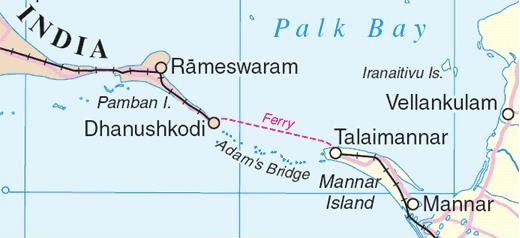
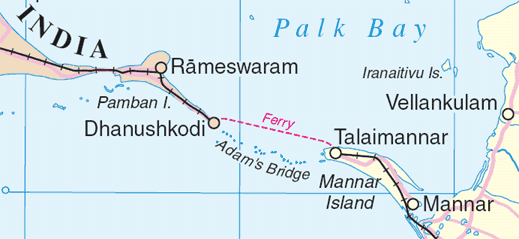
Rameswaram is a town on Pamban Island, in the southeast Indian state of Tamil Nadu. It’s known for Ramanathaswamy Temple, a Hindu pilgrimage site with ornate corridors, huge sculpted pillars and sacred water tanks. Devotees bathe in the waters of Agni Theertham, off the beach east of the temple. Gandamadana Parvatham is a hill with island views. A chakra (wheel) here is said to bear an imprint of Lord Rama’s feet.― Google
Pits made in the sand that provide sweet drinking water to the fishing community
Sweet drinking water found on the sandy beach flanked on both sides by the two oceans
The women
collect this water, filtering it through a piece of cloth in their
pots. They offer us some water. We are surprised to find that the water
is very sweet and free of any salt!
Women from the fishing communities collecting drinking water from the pits made in the sand
We
reach the end of the land where the two oceans meet and take in the
view of the deep blue sea, gradually changing colours with the setting
of the sun and the rising of the moon, wondering how such peace and
tranquility can at times, also unleash such fury and destruction, but
then, time goes on and heals all wounds!
References
1.
Dhanushkodi: The Wikipedia, the Free Encyclopedia. Downloaded from the
link http://en.wikipedia.org/wiki/Dhanushkodi on the 14th of March 2013
Rameswaram–Dhanushkodi
coastal tract lies in the south–east of Rameswaram Island, which
stretches about 20 km from the Rameswaram proper and occults several
historic values. The objective of the present study is to investigate
the water quality parameters viz., pH, electrical conductivity (EC),
total dissolved solids (TDS), salinity (SAL), total alkalinity (TA),
calcium hardness (CH), magnesium hardness (MH), total hardness (TH),
chloride (Cl), and fluoride (F) during summer and winter seasons…
A
study was carried out in the South-West, North-East and North-West
segments dividing the local area of Rameswaram Island to characterize
the physico-chemical characteristics of 87 groundwater…