Japanese researchers at Yokohama National University have introduced a game-changing alternative to conventional nickel and cobalt-based batteries for electric vehicles.
By leveraging manganese in the anode, they've achieved an impressive 820 Wh/kg energy density, surpassing current top-tier batteries.
This breakthrough not only promises higher energy efficiency but also offers a more sustainable and cost-effective solution for the growing EV market.
With a simplified synthesis process, the researchers aim to push the boundaries of battery technology, paving the way for a greener and more efficient future.
200 meteorites on Earth traced to 5 craters on Mars
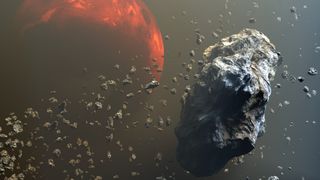
Illustration of a large meteorite above Mars.(Image credit: Pitris/Getty Images)
Believe it or not, debris from Mars has frequently made its way to
Earth after powerful impacts hit the Red Planet's surface and launch it
into space.
There have been at least 10 of these
meteorite-forming events in Mars' recent history. When these massive
impacts occur, meteorites can be flung away from the Red Planet with
enough velocity that they break free of Mars' gravitational pull to
enter orbit around the sun, with some eventually falling to Earth.
Scientists
at the University of Alberta have now traced the origins of 200 of
these meteorites to five impact craters in two volcanic regions on Mars,
known as Tharsis and Elysium. "Now, we can group these meteorites by
their shared history and then their location on the surface prior to
coming to Earth," said Chris Herd, curator of the university's meteorite
collection and professor in the faculty of science, in a statement.
Meteorites fall to Earth all the time — an estimated 48.5 tons (44,000 kilograms) of meteorite material falls each day, according to NASA
— though the majority make it to the surface as tiny unnoticeable
particles of dust. Determining their origins can often be difficult, but
in the 1980s, scientists became suspicious of a group of meteorites
that appeared to have volcanic origins with ages of 1.3 billion years.
This
meant that these rocks had to have come from a celestial body with
recent (in geological terms) volcanic activity, making Mars a likely
candidate. However, proof came when NASA's Viking landers were able to compare the composition of Mars' atmosphere with trapped gases found in these rocks.
Identifying
exactly from where on Mars they originated was previously difficult to
do. The team noted in their paper that this difficulty arose from using a
technique called spectral matching, a technique used to identify and
compare the composition of materials by analyzing the patterns of light
they absorb or emit.
However, this method is limited by factors
such as terrain variability and extensive dust cover, which can skew
spectral signals, especially on younger terrains like Tharsis and
Elysium. But knowing exactly where these Martian meteorites came from would allow scientists to better piece together the planet's geological past. "[It
would] enable the recalibration of Mars' chronology, with implications
for the timing, duration and nature of a wide range of major events
through Martian history," said Herd. "I call that the missing link — to
be able to say, for example, the conditions under which this meteorite
was ejected were met by an impact event that produced craters between 10
and 30 kilometres across."
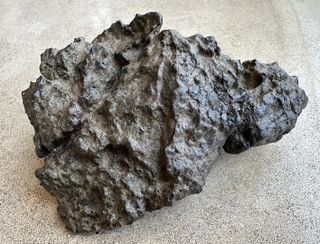
A Martian meteorite known as Amgala 001, found in Western Sahara in 2022. (Image credit: Wikimedia Commons/Steve Jurvetson)
The
team combined high-resolution simulations of impacts into a Mars-like
planet. "One of the major advances here is being able to model the
ejection process, and from that process be able to determine the crater
size or range of crater sizes that ultimately could have ejected that
particular group of meteorites, or even that one particular meteorite,"
said Herd.
The model's output allowed the team to determine the
impact events' "peak shock pressures" and the duration the rocks were
exposed to these pressures. This can be determined from "shock features"
observed in the meteorites—for example, unique mineral changes, impact
glass, and special fracture patterns.
From this data, Herd and
his colleagues were able to estimate the size of the impact craters that
could have launched the meteorites, as well as how deep the rocks were
buried before the impact. Although these depth estimates come with some
uncertainty, the researchers compared them with the local geology of
possible source craters and the characteristics and ages of the
meteorites to see if they align.
"[Our
modelling approach] allows us to say, of all these potential craters,
we can narrow them down to 15, and then from the 15 we can narrow them
down even further based on specific meteorite characteristics," he said.
"We can maybe even reconstruct the volcanic stratigraphy [the
geological record], the position of all these rocks, before they got
blasted off the surface."
This could help the scientists better
understand when volcanic events on Mars occurred, the different sources
of Martian magma, and how quickly craters formed during an era of low
meteorite bombardment on the Red Planet known as the Amazonian period,
some 3 billion years ago.
"It is really amazing if you think about
it," Herd added. "It's the closest thing we can have to actually going
to Mars and picking up a rock."
Join our Space Forums to
keep talking space on the latest missions, night sky and more! And if
you have a news tip, correction or comment, let us know at: community@space.com.
A
chemist turned science writer, Victoria Corless completed her Ph.D. in
organic synthesis at the University of Toronto and, ever the cliché,
realized lab work was not something she wanted to do for the rest of her
days. After dabbling in science writing and a brief stint as a medical
writer, Victoria joined Wiley’s Advanced Science Newswhere she
works as an editor and writer. On the side, she freelances for various
outlets, including Research2Reality and Chemistry World.
it only takes a slight amount of sunlight to guide solar sails
through space. Though photons don't have mass, they can force momentum
when they hit an object — that's what a solar sail takes advantage of.
The Covestro Photon is the third generation of solar car
they have created. It is a solar electric car powered via solar panels.
Efficiency was crucial in the design of the Photon: due to its
catamaran design, the Covestro Photon is only half as tall as a racing
bike, which means its aerodynamic drag is extremely low.8 Feb 2022
Solar vehicles are electric vehicles that use self-contained solar cells to provide full or partial power to the vehicle via sunlight. Solar vehicles typically ...